Fedor Dmytrovych Berezin
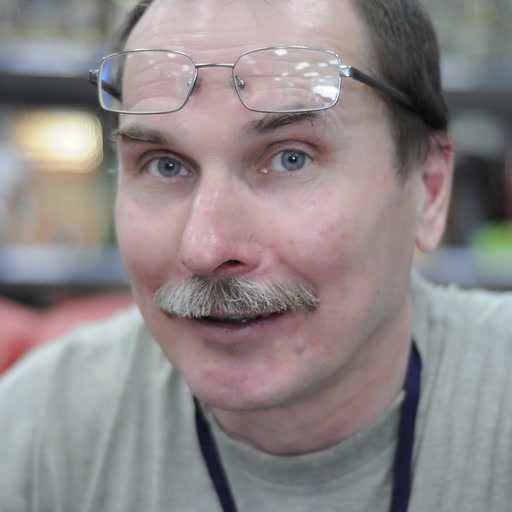
Birth: 1960, Donetsk, Ukrainian SSR Occupation: Former Soviet air-defense missile officer, science fiction writer Languages: Russian Notable Works: Voyna 2010: Ukrainskiy front, Krasnye zvezdy, Voyna 2030 Affiliations: Soviet Air Defense Forces (1981–1991); from 2014, official of the "Donetsk People's Republic"
Biography
A Soldier of a Vanishing Empire
Fedor Berezin was born in Donetsk in 1960 and graduated from the Engels Higher Anti-Aircraft Missile Command School, the USSR's premier training institution for Air Defense officers. From 1981 to 1991 he served as a missile officer in Kazakhstan and the Soviet Far East, in units built to intercept a specifically Western threat. His professional identity was built, over a full decade, around vigilance against an enemy that never came.
After retiring in 1991 he worked as an entrepreneur and, for four years, as a vertical-shaft driller in a Donetsk mine, while establishing himself as a writer.
"Future War" Fiction
Between the early 2000s and early 2010s, Berezin published a sequence of "future war" novels imagining renewed conflict between Russia and NATO: the Krasnye zvezdy dilogy and Yadernyi rassvet, Voyna 2010: Ukrainskiy front (2009) and its sequel (2010), and the two-volume Voyna 2030 cycle. Published years before 2014, they fixate on Donetsk, Luhansk, Mariupol, and Crimea as the geography of a coming war, layered with conspiracist plotting about hidden directorates and staged revolutions. Berezin described the fall of the USSR as the death of "a whole civilization" he still mourns — comparable, he told The New Yorker, to the fall of Rome.
From Novelist to Combatant
In June 2014, Berezin was named deputy defense minister of the newly proclaimed "Donetsk People's Republic" by Igor Strelkov (Girkin), who confirmed the appointment to a journalist with "Confirmed. We'll see how he handles it." Berezin later told The New Yorker that moving from novelist to combatant was simple: "In 2009, I had already written a novel about war in the Ukraine." He has remained embedded in the DNR's institutions for over a decade — deputy defense minister, tank-battalion officer, and chairman of its Writers' Union, which he has himself described as "a combat cell." As of 2024 this has produced an in-absentia Ukrainian conviction for collaborationism.
Rehearsal, Not Prophecy
A "seer" myth grew up around Berezin after 2014, and he cultivated it — telling The New Yorker that "some publishers here call me the Russian Tom Clancy." The evidence points elsewhere. His fiction worked less as prophecy than as rehearsal: two decades of writing had supplied the script and the villains, so that when the war arrived he already knew his lines.
The most striking passage appears in Red Stars / Nuclear Dawn, published in 2013 — one year before the war. Contrasting a timeline where the USSR collapsed with one where it did not: "Only in World-1 could Donbas be meekly gifted to a republic which suddenly, at the prompting of overseas senators, decided to secede from the Union… Here, in World-2, they would simply have started a war for Donbas. And they would have won."
War 2010 had gone further four years earlier, describing unrest that reads almost as reportage from spring 2014: "in recent days Donbas has been seething with indignation over events in Kyiv. In the regional centre alone an anti-NATO rally gathered around fifty thousand people… Donbas demands an all-Ukrainian referendum on joining or not joining the military bloc." Rallies against a Kyiv government perceived as illegitimate, a referendum demand, and an amphibious assault on Mariupol staged from Kerch — all in a 2009 novel.
Its sequel contains a briefing scene worth quoting for what it inverts. A Soviet-loyalist general explains the war's hidden architecture: "First, the attack by Turkish armed forces… Simultaneously an information blockade is imposed… rumours are deliberately spread that Russia has attacked Donetsk… Then the Kyiv gang appeals to NATO… And so NATO troops arrive in the guise of saviours." Point for point, this is the disinformation playbook later attributed to Russia itself, rehearsed four years early with the roles reversed.
The mourning is literalized as plot machinery: in War 2030 the clandestine directorate that restores Russian power is called the Center of Rebirth — the same word Berezin reached for in 2016 when he said of the USSR, "one day I hope it will be reborn."
The Image of Ukraine
It is the narrator's voice, not only individual characters, that treats Ukraine with contempt. The ethnic slur khokhol appears more than ten times in The Ukrainian Front alone — "truly, these ruddy-faced khokhols deserved to be despised to the depths of the soul" — and curdles into denial of nationhood: "And what kind of special nation are the khokhols (pardon me, Ukrainians)? Somebody made up this nickname and you answer to it."
The register slides into dehumanisation: "Ukrainian monkeys, contemporaries of the Neanderthals"; a Russian-speaking region populated by "absolute sub-humans." The country is personified in degrading sexual terms — "spread out below with her legs open for her dear foreign guests." Ukrainian speech is rendered phonetically for comic effect; the army is inept, its soldiers sharing "a single bayonet"; the Holodomor becomes a "mound labelled 'The Holodomor — Ukraine's chief national treasure'."
Some of this is framed as parody of Ukrainian nationalist rhetoric. But the sub-human formulation borrows directly from Nazi race theory, so the insult lands twice — once as parody, once through the borrowed vocabulary. Individual Ukrainian characters occasionally escape; they are exceptions inside a frame that otherwise treats Ukraine with contempt.
Contemporary Assessments
Dmitry Bykov argued in Novaya Gazeta that the war "was unleashed by re-enactors, columnists of the newspaper Zavtra, and science-fiction writers." Petr Silaev described the subgenre's wish-fulfilment logic precisely: "All battles are unconditionally won by 'ours'; none of the protagonists die, while all the enemies do."
Cathy Young offered the most quoted formulation — "it seems Berezin genuinely believed what he wrote… and is now putting it into practice" — while limiting the causal claim: print runs were five to six thousand copies, so "you cannot say the market was flooded with this propaganda. But we can say that all this literature… played a role in preparing the ground for the current conflict." Where Remarque and Hemingway turned combat trauma into antiwar literature, Berezin and his peers "reproduce the 'romance of war' — which they go on to reproduce again in real life."
One irony: Ukraine's future interior minister Arsen Avakov knew Berezin through the Starbridge convention he co-chaired and wrote admiringly of the subgenre in 2009; by 2014 he was calling him a terrorist.
Selected Works
- Пепел (Ash); Красные звезды dilogy; Ядерный рассвет
- 2009 – Война 2010: Украинский фронт (War 2010: The Ukrainian Front)
- 2010 – Война 2011: Против НАТО (War 2011: Against NATO)
- Война 2030: Красный рассвет, Пожар Метрополии
Note on this entry
Whether Berezin belongs on a list of Ukrainian authors is a fair question: he holds Ukrainian citizenship and has spent most of his life in Ukraine, but writes in Russian and is animated by contempt for the country. He is included because his novels ceaselessly rehearse war on Ukrainian territory, making Ukraine the central stage of his fictional universe.