Sandro Kasyanyuk
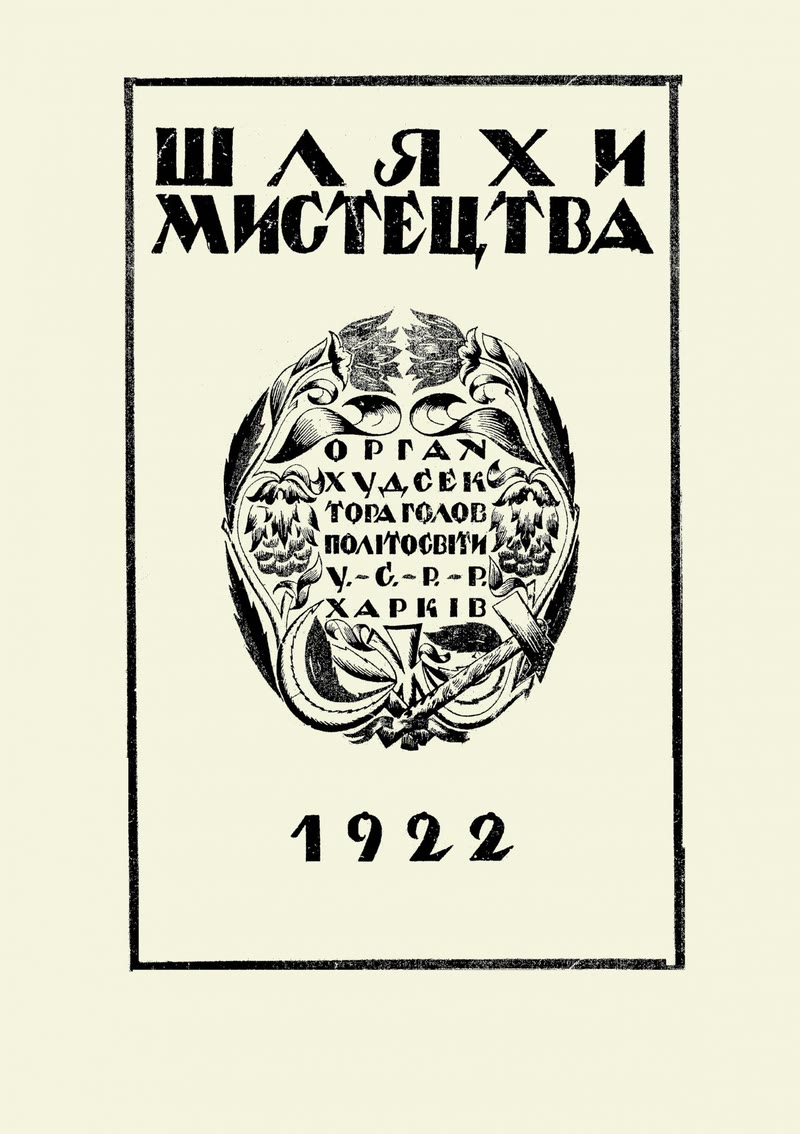 No photograph of Kasyanyuk is known to exist. Shown instead: the 1922 title page of Шляхи мистецтва (Ways of Art, Kharkiv), the journal that printed "Кроки перші" on pp. 29–34 and called it "the beginning of Ukrainian proletarian prose." Scan: Korolenko State Scientific Library, Kharkiv.
Sandro Kasyanyuk – Ukrainian Soviet Writer and Pioneer of Proto-Science Fiction
Biographical Overview
Sandro Kasyanyuk (presumably Alexander Kasyanyuk) was a Ukrainian Soviet writer of the 1920s, known for his early contributions to Ukrainian proto-science fiction. Little is known about his birth date, place of origin, or personal background. He was not a professional writer; instead, he worked as a factory worker at the "Elektrosila" plant in Kharkiv. Despite this, his literary works were highly regarded by contemporary critics, and he was associated with the Ukrainian proletarian literary organization "Hart."
Kasyanyuk's most notable work is the cycle of science fiction stories titled "Omachynennia Liudstva" ("The Mechanization of Humanity"), considered the first example of Ukrainian proto-science fiction.
The First Literature of Techno-Communism
Kasyanyuk wrote at the moment when Soviet modernization was being run as a positivist programme. Marxism and positivism shared a materialist base, a faith in scientific method, and a rejection of metaphysical speculation, so Marxism could operate as a political adaptation of positivism — a method of understanding reality converted into a tool for changing it. Lenin's formula, "Communism is Soviet power plus the electrification of the whole country," was not a slogan to Kasyanyuk's generation but an equation they were expected to solve.
The result was what can be called techno-communism: a system in which machines are so central to building a classless society that people are treated as components of the technological process. Katerina Clark observed that in this period "the machine became the dominant cultural symbol for Soviet society," with the individual conceived as a "part" of that greater whole. Kasyanyuk's "Nova Utopiya" may be the first literary expression of this outlook anywhere in Ukrainian letters — and, crucially, he registers none of its costs. His utopia ends with a senior mechanic issuing a command to the narrator: "Step into the machine!"
Machines as Lovers
The most striking and least discussed feature of Kasyanyuk's prose is its eroticisation of machinery. In "Mashynovi Dushi" ("Machine Souls"), the second part of First Steps, an oilman tends a steam engine in language that reads as courtship: he strokes "the giant's elbow," feels its warmth, and seems "ready to hug this giant." Technically the scene is nonsense — machines do not require constant lubrication by a dedicated worker — but accuracy is not the point. The text is closer to industrial pornography than to reportage, and it opens with an instruction: "You have to be mechanized yourself."
"Mashynove Vesillia" ("The Mechanical Wedding") takes this to its conclusion, staging the marriage of a Ukrainian male Engine to a German female Dynamo turbine, complete with genealogy, courtship, and consummation — "they touched shaft to shaft, that is, heart to heart." The impulse was not uniquely Ukrainian: Fritz Lang's Metropolis (1927) gave its scientist a robot built to replace a dead wife. But Kasyanyuk pushes the personification further than his contemporaries, and does so without irony.
Style, Language, and an Unexplained Shakespeare
Kasyanyuk exemplified the archetype of the "proletarian writer" — a category the Party valued precisely because such authors lacked literary training and were therefore thought better attuned to political purpose. His first publication carried an editorial note declaring it "the beginning of Ukrainian proletarian prose." That note also betrays the editors' uncertainty about what they had received: a story, a description of a work process, or an "artistic reportage"? This ambiguity is itself characteristic of early science fiction.
His language is colloquial and unpolished, drawn from newspapers, radio, and overheard speech rather than from books. Watching a piglet, he catalogues its movements and concludes with a single word — Машинерія! ("Machinery!") — a calque of the English term he had probably heard rather than read. His stories lack consistent protagonists; characters appear and vanish, and the author inserts himself without transition.
One detail resists this picture entirely. In New Utopia, where a ship berates its Ukrainian crew, Kasyanyuk writes in something close to Shakespearean meter. Given the near-total absence of biographical record, there is no way to establish whether he had read the tragedies, seen them staged, or arrived at the rhythm by accident.
Colonial Echoes and the Radio That Brought No Happiness
That same passage carries an unmistakable postcolonial charge. The ship — an exploiter, and therefore in Kasyanyuk's schema a capitalist — issues its orders to Ukrainian workers in Russian and Polish, threatens punishment for disobedience, and shouts chauvinist slogans. The arrangement mirrors how Russians and Poles were experienced in parts of Ukraine: as colonisers imposing order at local expense.
"Hai ta Radio" ("The Groves and Radio") records villagers pooling their savings to buy a radio set, membership of the local Society of Friends of Radio growing by hundreds in a single week. Kasyanyuk never asks what they will actually hear. With no free press in Soviet Ukraine, the radio functioned as propaganda rather than information — and the Holodomor, which would kill millions of these same peasants, lay six years ahead and would go unreported. Ilf caught the disappointment a few years later: "Earlier in science fiction, radio was the main thing. People expected happiness for mankind from the radio. Now we have a radio, but we have no happiness."
Literary Contributions and Reception
The prominent Ukrainian literary scholar Oleksandr Biletsky believed Kasyanyuk could have become "the Ukrainian H.G. Wells with a proletarian ideology," while judging his talent "still in an embryonic state." By 1928 Biletsky was using him as a measuring stick against a far greater writer, remarking that Vynnychenko's indifference to machines was a deficiency Kasyanyuk "could teach him a lot" about. Volodymyr Koriak also valued the work. Walter Smyrniw later concluded that neither the structure nor the content of the essays qualifies as true science fiction, though "in the 1920s, propagandists of proletarian literature were ready to recognize" them as an experimental form of it. His writings have also been analyzed by Vasyl Pivtoraadni and, more recently, by Yaryna Tsymbal, who reads the whole Omachynennia Liudstva cycle as proto-science fiction.
What none of these critics attempted was to place Kasyanyuk within techno-communism. The term did not exist, and the phenomenon was so ordinary a feature of their daily lives that it passed unnoticed.
Bibliography
- 1922 – "Kroky Pershi" ("First Steps") – published in Shliakhy Mystetstva literary journal, Issue No. 1(3)
- 1922 – "Nova Utopiya" ("A New Utopia") – published in Shliakhy Mystetstva literary journal, Issue No. 2(4)
- 1923 – "Zatoky Zhyttia" ("The Bays of Life") – a play, published separately by "Hart" publishing house in Kharkiv
- 1925 – "Mashynove Vesillia" ("The Mechanical Wedding") – published in Kultura i Pobut newspaper, Issue No. 12
- 1927 – "Hai ta Radio" ("The Groves and Radio") – published in Kultura i Pobut newspaper, Issue No. 7
His play "Zatoky Zhyttia" ("The Bays of Life") was published separately with the help of Valerian Polishchuk, a key figure of the "Executed Renaissance", a generation of Ukrainian writers repressed by the Soviet regime.
Legacy and Recognition
Although Kasyanyuk's exact date of death remains unknown, it is confirmed that he lived beyond 1927. He was not a skilled builder of plots or sentences, and his significance lies elsewhere: he functioned as a naive mirror, registering the sensation of early techno-communism with an immediacy no accomplished writer preserved. He believed technical progress would produce good outcomes by itself and never suspected it might do otherwise — a positivist illusion typical of the early twentieth century and by no means confined to Ukraine.