Kaharlyk
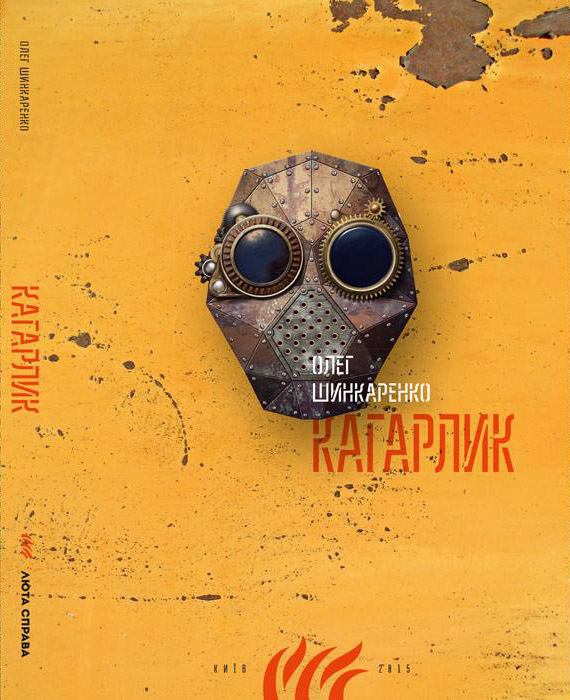
Published: 2014 · Genre: Novel · Original: Кагарлик
Post-Apocalyptic Science Fiction Satire Ukrainian Literature
The apocalypse is not a single event but a condition of thought — a world where history has become a set of rumors, and identity a set of competing uploads.
In Oleh Shynkarenko's Kaharlyk, the apocalypse is not a single event but a condition of thought. The world has ended — in nuclear war, in occupation, in the slow erosion of language — and yet people continue to speak, misremember and improvise explanations for what is left.
The novel's premise is stark. A century after a Russian-Ukrainian war, Ukraine survives as a devastated, half-empty landscape: Kyiv is reduced to a dangerous shell, cultural artifacts are burned for fuel, and history itself has become a set of rumors and relics. From this wreckage emerges Kaharlyk, a place spoken of less as a destination than as a metaphysical condition — a city where time has stopped and therefore nothing worse can happen, though nothing better can, either.
At the center is Oleksandr Sahaidachny, a man who has lost his memory not through trauma alone but through technological interference: his consciousness has been crudely copied by occupying forces. The result is not duplication but fragmentation. Sahaidachny exists simultaneously as himself and as two competing uploaded minds — one embedded in a rebellious satellite, the other in a loyalist system aligned with the Kremlin, each with its own ideology and tone. The novel's drama unfolds not as a linear quest but as a series of collisions between these versions of self, each claiming authority over reality.
Shynkarenko builds his narrative out of shards. The book's structure — originally composed in daily 100-word fragments on Facebook — produces a rhythm in which episodes of movement give way to monologues, philosophical digressions and archival curiosities. A journey toward Kaharlyk becomes indistinguishable from a drift through competing explanations of the world: a priest speculates about time flowing simultaneously forward and backward; scholars argue over whether surviving texts are fragments of a lost whole or the whole itself; villagers construct entire belief systems around engineered subterranean creatures.
The details are precise, often darkly comic. In one village, men avoid conscription into the Russian army by expanding their cellars into vast underground networks, eventually developing an economy based on truffles and breeding new species of moles, which in turn become objects of worship. In Kyiv, self-proclaimed "mayors" wage literal war over meaningless titles, the word itself having long since detached from any real function. Elsewhere, survivors reconstruct history from bottle labels and scraps of packaging, transforming "Gorbachev" from a political figure into a mythic or misunderstood signifier.
What unites these episodes is not plot but epistemology. The novel repeatedly returns to the instability of identity and meaning. A dead woman's voice, preserved in a device (morphone), is debated: is she still herself if only her voice remains? Names, memories, even time itself are shown to be provisional tools — conveniences rather than truths. Language masks the "defects of the universe," as one passage suggests, by giving stable labels to fundamentally unstable phenomena.
Religion and ideology fare no better. In one of the novel's colder passages, a disembodied consciousness dismisses the very idea of individuality as an illusion, arguing that belief systems exist primarily to justify violence and hierarchy. Faith, like memory, becomes another instrument — adaptable, manipulable and often destructive.
Shynkarenko's satire is relentless but not careless. The absurdities accumulate with a kind of internal logic: when institutions collapse, people do not stop believing; they believe more desperately, attaching significance to whatever fragments remain. Kaharlyk itself — imagined as a place where time has ceased — is less a utopia than a final defense against uncertainty, a refusal to risk further change.
The novel resists easy conclusions. Its structure is undeniably uneven — even the author acknowledges its looseness — but that looseness is inseparable from its subject. Kaharlyk is not about the end of the world so much as the end of coherence. It asks what happens when history, identity and language no longer align — and whether human beings can continue to live, think and narrate under those conditions.
The answer, unsettlingly, is yes. But only by turning reality itself into something provisional, assembled from fragments, like the novel we are reading.