Cherep
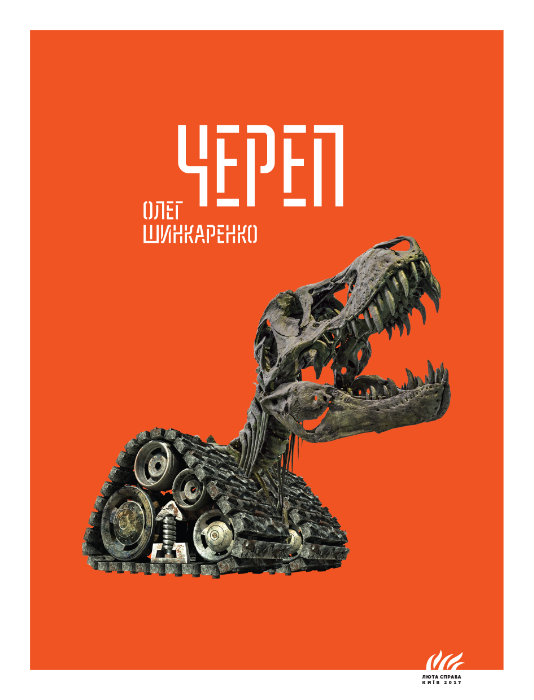
Published: 2017 · Genre: Novel · Original: Череп
Political Fiction Grotesque Satire Ukrainian Literature
War begins not with weapons, but with language that erases ambiguity — an immersive model of how imperial consciousness operates from within.
Oleh Shynkarenko's Cherep is not a conventional war novel — and calling it satire alone undersells its ambition. It is closer to a grotesque hallucination built out of propaganda clichés, imperial myths, and collective resentment. The novel does not simply critique Russian imperialism; it dissects the mental machinery that makes it possible.
At the core of the book is an absurd yet revealing premise. Three characters — a distorted, almost folkloric trio of "bogatyrs" — set off from the far reaches of Russia toward Ukraine in a T-34 tank, painted like a decorative artifact, to fight mythical "Banderivets" invented by Russian media spin doctors. What begins as parody quickly turns into something darker: a journey not through geography, but through layers of ideological delusion.
The world they move through obeys no stable logic. Reality mutates into a fairy-tale space that resists physics, reason, and common sense. This instability is not stylistic excess — it mirrors the epistemic breakdown produced by propaganda. In Cherep, the environment itself becomes unreliable because the characters' perception has been colonized.
What drives the narrative is not action but belief — or rather, imposed belief. The protagonists are not fully autonomous agents; they are vessels of slogans, historical simulacra, and recycled narratives. At one point, propaganda is explicitly framed as a necessary tool: repetition ensures that enemies are always perceived as "fascists," making violence not only acceptable but inevitable. The novel captures something essential here: war begins not with weapons, but with language that erases ambiguity.
As the journey unfolds, the characters gradually lose any remaining humanistic coordinates. They retain only one capacity — obedience to the hypnotic logic of propaganda, which nurtures a "monster of resentment." This is perhaps the novel's most unsettling insight. Imperial violence is not portrayed as strategic or rational; it is emotional, rooted in ressentiment, humiliation, and mythologized history.
Shynkarenko sharpens this critique through relentless satire. Media narratives collapse into absurdity: fabricated reports, contradictory "facts," and staged realities expose how truth is manufactured. A striking episode shows journalists scrambling to explain an obviously false military report — not to uncover truth, but to make the lie convincing. Here, the novel moves from satire to diagnosis: propaganda is not a distortion of reality but a system that replaces it.
Stylistically, Cherep embraces excess. Its language oscillates between crude colloquial speech, ideological jargon, mystical nonsense, and pseudo-philosophical rambling. This cacophony is deliberate. It recreates the noise of a media-saturated environment where meaning is constantly produced and dissolved. The result is disorienting, sometimes exhausting — but also precise in its effect.
Importantly, the novel does not offer a moral counterweight or a clear position of stability. There is no "outside" perspective that restores order. Instead, readers are trapped inside the same distorted reality as the characters. This is what makes Cherep more than satire: it is an immersive model of how imperial consciousness operates from within.
Ultimately, Cherep is about the fatal convergence of myth and media. It shows how imperial ambition survives not through coherent ideology, but through a constantly shifting fata morgana — a mirage sustained by repetition, fear, and desire. The war that emerges from this system feels both inevitable and unreal, like a nightmare that no one fully understands but everyone participates in.
If The First Ukrainian Robots explored the dissolution of the human in a technological system, Cherep confronts a different kind of collapse: the disappearance of reality itself under the pressure of narrative. It is a harsher, more chaotic book — less structured, more aggressive — but also more direct in its political charge.
Shynkarenko does not ask the reader to laugh comfortably. As the preface suggests, laughter is not enough — one must be horrified.