Metamodern Timescapes: The Changing Image of Time
It is fairly obvious that time is not a tangible object, yet we treat it as if it were one. This delusion is rooted in the significant role time plays in our lives and the many, sometimes very precious, devices for measuring time that surround us.
For example, the most expensive clock in the world is the Graff Diamonds Hallucination, a wristwatch valued at $55 million. It features more than 110 carats of extremely rare and colorful diamonds set in a platinum bracelet, making it a unique blend of exquisite jewelry and watchmaking. (Graff Diamonds Hallucination 2025) Big Ben (the clock and bell inside the Elizabeth Tower, London) does not have a formal market value since it is a historic landmark, state property, and an irreplaceable symbol of British heritage. However, the most recent restoration costs for the entire tower—including the clock mechanism and bell—have reached nearly £80 million (about $97–111 million USD) as of 2022. (Washington Times 2025) The global watches and clocks market size in 2025 is estimated at approximately $58.94 billion USD. The market is projected to grow further, reaching about $71.75 billion USD by 2029. This includes all types of time-measuring devices such as wristwatches, wall clocks, desk clocks, and smartwatches. (Clocks Market Share 2025)
It’s hard to believe that such a gigantic sum of money is invested in something that lacks any material representation, yet that’s the reality. Let’s open the Oxford English Dictionary for an example of a definition: “Time. (uncountable) what is measured in minutes, hours, days, etc.” (Oxford 2025) If time is uncountable, that means nobody can count time by saying, “I had five times, but I lent two times to my friend until next Monday.”
“Time is a measured or measurable period and a continuum without spatial dimensions”, Britannica says (Britannica 2025). And it sounds very foggy, because we can easily imagine a continuum of a space, but what is a continuum without spatial dimensions? “A number, as of years, days, or minutes, representing such an interval: ran the course in a time just under four minutes”, explains the American Heritage Dictionary of the English Language. (Dictionary 2012) And it is much more productive in terms of understanding.
Hours, minutes, and seconds originated from ancient civilizations’ need to divide the day for practical reasons. Nobody knows for sure, but it is believed that one of the ancient Egyptians or Babylonians counted the joints of his long fingers using his thumb and discovered there were twelve. Thus, we have twelve hours of day and twelve hours of night. (Britannica 2025, 2)
Perhaps later, the same Babylonians invented the base-60 system that gave us minutes and seconds. Remarkably, modern empirical science is still built on this ancient finger-counting system. Just imagine if those ancient Egyptians had used a finger from their other hand to count the joints — they would have counted fourteen. In that case, our day would consist of twenty-eight hours, which would lead to many unexpected consequences.
For example, each new hour would be shorter:
Accordingly, minutes and seconds would also be shorter in the same proportion. If the speed of light in a vacuum is now c = 299,792,458 meters per second, the new value of this constant would be:
Thus, the “speed of light” would depend on one extra thumb of the ancient Babylonians. Of course, the actual speed of light remains constant: “Calendar reform will not shorten pregnancy” (Lec 1972) — but for us humans, any constant exists only as a measurable phenomenon.
This simple example shows that the very essence of time depends on people’s mutual agreements. Time is not a real physical object but a construct — the result of our collective conventions. If so, it would be both useful and fascinating to trace how and why this construct of time has evolved over the centuries up to the present day.
Ancient concept of time
In the past, the concept of time arose from social interactions to measure the duration of work and ensure a fair distribution of labor or determine a competition winner, but the precision of time-measuring devices often varied greatly.
Before accurate chronometers appeared in the 18th century, sailors used hourglasses to measure time intervals for dead reckoning — estimating a ship’s speed and distance traveled. “Starting in the 14th century, and until the appearance of marine chronometers, at sea, the time was regulated each day at noon, when the sun was at its highest point. A sundial was used for this purpose, and the hourglasses were then used to measure the passage of time during the day. The 30-minute hourglass was used to measure the length of watches. Each time the hourglass was turned, the helmsman would sound the ship's bell – one ring, or "bell", after the first half-hour, two after the second, and so on, until "eight bells" marked the end of a four-hour watch”. (Navigation and Time 2025)
This precision was necessary due to the complex nature of around-the-globe expeditions, which required highly accurate measurements for their success. However, it is useful to view time management from a perspective distant from the main centers of civilization, to see that sundials, hourglasses, and chronometers are not essential devices—and that the very measurement of time can take different forms under different social conditions.
Douglas Raybeck in his article “The coconut-shell clock” (1992) found that notions of time among Kelantan Malays help to maintain “village solidarity and… their distinctive cultural identity” (Raybeck 1992)
In traditional Kelantanese villages, time is social and experiential, tied to natural and social rhythms rather than mechanical hours. People describe time in relation to activities, like “before Zohor” for midday prayer, instead of precise clock hours. Punctuality is judged socially—lateness matters only if it disrupts harmony or causes embarrassment. Mechanical watches arrived with modernization, but villagers often wore them as symbols of status or modernity rather than accurate instruments. As people in Africa say, “Westerners have watches. Africans have time.” (Guinness 2016). A stopped or broken watch still “worked” culturally, expressing identity, aspiration, and awareness of Western time. The coconut-shell clock is a local timer used in competitions. “This is a simple construction consisting of a pail of water in which is floated a half coconut-shell with a small hole bored through the center. The measured interval is simply the amount of time it takes for the shell to fill with water and sink, usually three to five minutes”. Though technically imprecise, the coconut clock is preferred for its visibility and fairness, allowing everyone to see the timing. This timer emphasizes social exactness over physical precision, preventing envy and conflict within the community. Using a hidden mechanical watch would undermine trust, whereas the coconut clock protects harmony and transparency. In Kelantan, time serves human relationships first, showing that cultural meaning and social participation outweigh strict temporal accuracy. (Raybeck 1992)
It is clear that the coconut-shell clock was sufficient in societies where time held little economic importance and was largely inconsequential. In simple terms, it was worth almost nothing. However, the Industrial Revolution in Western societies greatly increased the value of time. In 1748, Benjamin Franklin wrote in his essay Advice to a Young Tradesman, “Remember that time is money” (Fisher 1748). When one must literally pay for another person’s time, even a difference of “three or five minutes” becomes crucial, demanding an entirely new level of precision.
From the Newton “medieval” idea of absolute time to Einstein relativity Newton was one of the first scientists to notice that, while sand, solar, and even mechanical clocks measure time with varying degrees of accuracy, there must exist a certain ideal, absolute “super-clock” to which real clocks only approximate in precision. This idealism was a common tendency among many scientists of that era, when the authority of religion was shaken during the Enlightenment but still strong enough to punish those who disagreed with the official view of the universe. Thus, idealism became a transitional stage from a religious worldview to positivism.
Newton lived in a time when physics did not yet have a unified system for describing motion. Observing the movement of planets, the falling of bodies, and phenomena of inertia, he realized that an accurate description of motion required a constant “stage,” independent of events, on which motion occurs. This led him to the concept of absolute time—time that flows uniformly and independently of any external phenomena or observations. He distinguished between absolute time (mathematically constant, “in itself”) and relative time (which we measure with clocks by observing events). For example, a clock might run fast or slow due to mechanical limitations, but absolute time flows steadily regardless.
To support his hypothesis, Newton conducted the famous bucket experiment. By rotating a bucket of water, he observed the water’s surface curving from the center toward the sides due to centrifugal force. When the bucket was stopped, the water continued to rotate and maintained the curved shape for some time. According to Newton, this effect demonstrates that the motion of an object relative to absolute space and time has physical consequences that cannot be explained merely by the relative motion between two objects: the water and the bucket. Newton could not have imagined then that the water in the bucket was under the influence of inertial force not so much relative to the walls of the bucket, but rather relative to the Earth's gravity. At a certain distance from the Earth, a similar experiment would not be possible at all.
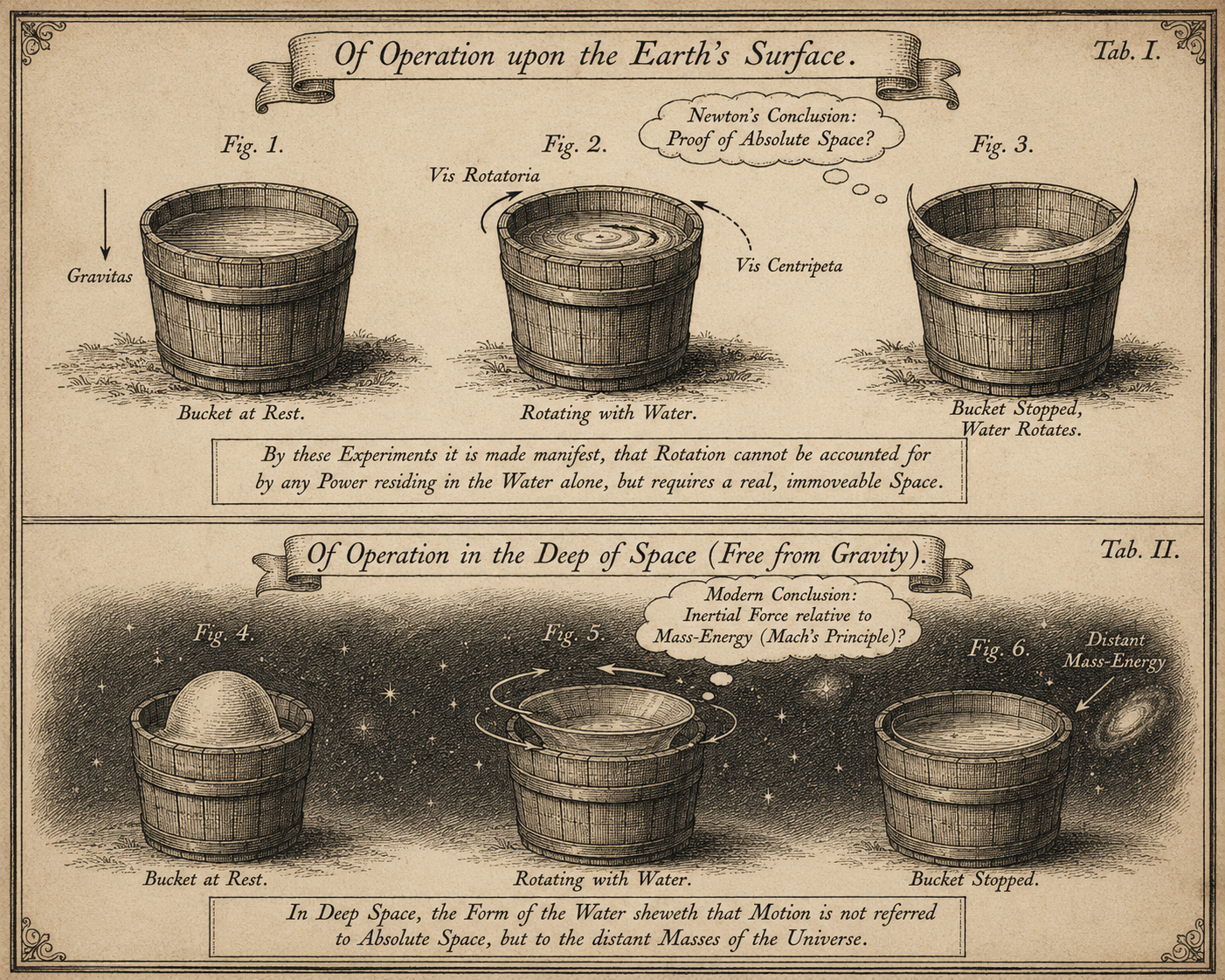
Figure 1. Newton's Bucket Experiment scheme under two conditions: on Earth and in space.
This idea persisted for almost 300 years, until Einstein’s Theory of Relativity emerged. The most interesting point in the context of this article, however, is Ernst Mach’s remark: "No one is competent to predict things about absolute space and absolute motion; they are pure things of thought, pure mental constructs, that cannot be produced in experience”. (Mach 1960) Mach saw in Newton’s idealism “medieval” notions of absolute space and absolute time. (Galison 2003)
It only became definitively evident in the 20th century that it is impossible even to imagine absolute reference frames, because our planet, our Solar System, and even our Galaxy are continuously moving at enormous speeds, and therefore, both temporal and spatial measurements depend on the reference frame.
Between 1900 and 1905, Albert Einstein worked at the Swiss Patent Office in Bern and was working on the problem of synchronizing clocks at the railway station. It was there that the idea of the impossibility of events being simultaneous for all observers occurred to him. Imagine a platform 300,000 kilometers long, at both ends of which two lights are simultaneously switched on at a moment we designate as “0.” Light travels from one end of the platform to the other in 1 second. A passenger stands in the middle of this platform. For them, the clocks will turn on simultaneously, but half a second after they turn on for the two passengers standing next to those two lights. Thus, this will happen at moment “0.5.” A train approaches the platform, and its driver will see the first light, the closest to him, at moment “0,” and the second light—the distant one—at moment “1.” If the engineer switches on a light on the train exactly at the moment he sees the distant light, the distant passenger will notice this at moment “2.”
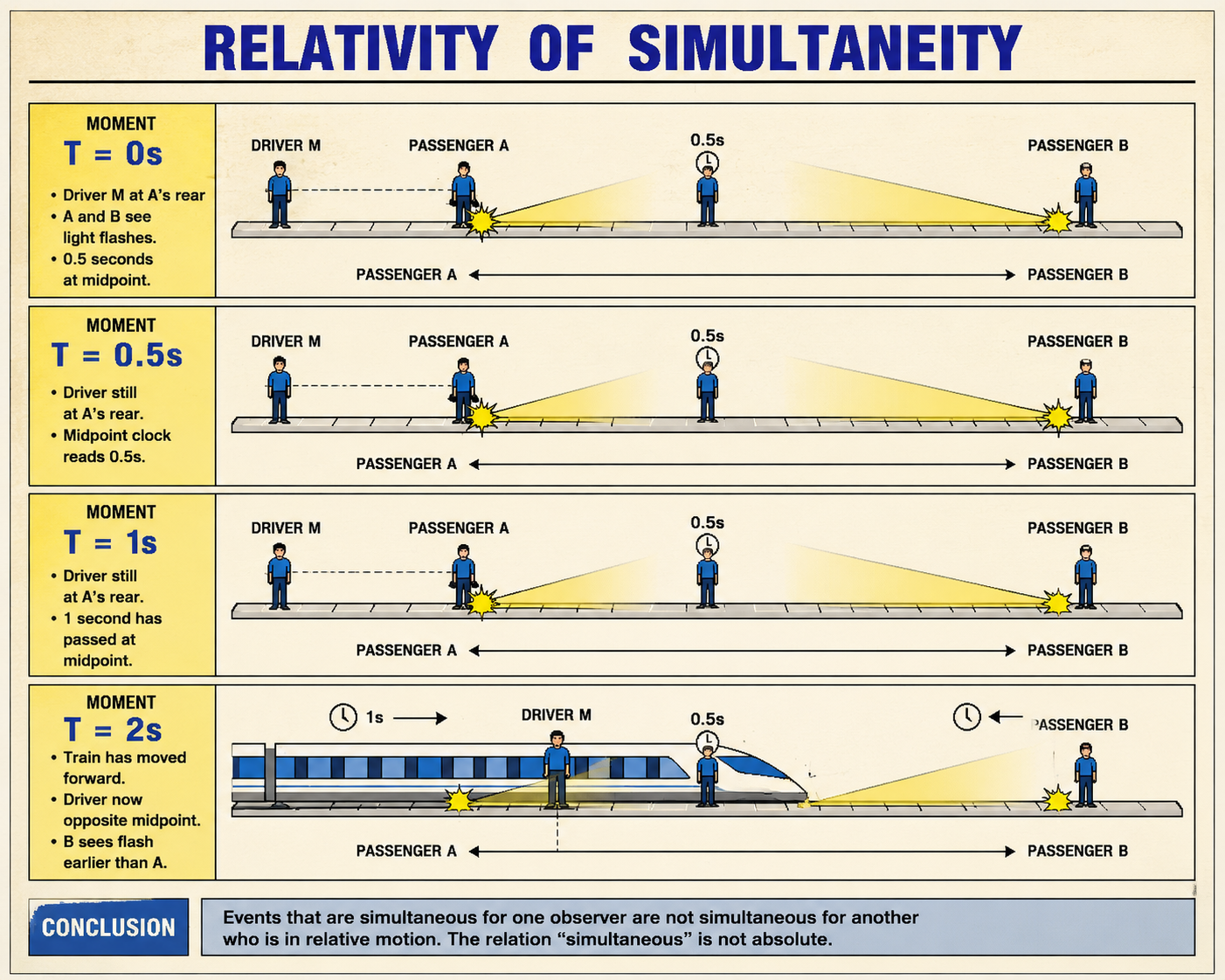
Figure 2. Illustration of the relativity of simultaneity.
Thus, the idea of visually synchronizing clocks turns into an almost impossible problem to solve, as there are no means to transmit information faster than light.
Einstein argued that a better and nonarbitrary solution to the simultaneity question was this: set clocks not to the time that the signal was launched, but to the time of the initial clock plus the time it took for the signal to travel the distance
from the initial clock to the clock being synchronized. Specifically, he advocated sending a round-trip signal from the initial clock to the distant clock and then setting the distant clock to the initial clock’s time plus half the round-trip time. In this way the location of the “central” clock made no difference–one could start the procedure at any point and unambiguously fix simultaneity. (Galison 2003)
It was not easy to abandon the idea of absolute time, but it was even more difficult to relinquish the concept of objective time, which exists as an element of physical reality independent of human consciousness and is not merely a product of our minds. Due to the complexity of accepting this fact, fierce debates began and persisted throughout the 20th century between Presentists and Eternalists.
Presentism, eternalism and McTaggart’s dead-end
Despite the latest staggering scientific discoveries, Idealism continued to defend its positions. J. M. E. McTaggart was one of the most prominent representatives of British Idealism, a school of philosophy that opposed the growing scientific materialism and empiricism of the time. His commitment to Idealism was deeply rooted both in his academic heritage as a follower of Hegel.
Thus, his systematic philosophy, presented in his work The Nature of Existence (McTaggart 1921), was an attempt to construct a worldview that would provide a spiritual anchor and solace. This worldview asserted that true reality is Absolute, non-temporal, and composed of eternal essences (minds) bound by love. His argument for the unreality of time was a key part of this consolation: if time is unreal, then suffering, change, and death are illusions, and the true essence of existence is eternal and good.
McTaggart, like other British Idealists, saw a threat in science (and the materialism it generated) to the human spirit and eternal values. His argument that time is contradictory, and thus illusory, was a direct blow to the scientific worldview, which is based on physical, temporal existence. By proving that the foundations investigated by science are unreal, he defended the supremacy of spirit and eternity over matter and time.
In a famous paper “The Unreality of Time” published in 1908, J. M. E. McTaggart argued that the appearance of a temporal order to the world is a mere illusion. His argument begins by distinguishing two ways time positions can be ordered:
-
the A-series (defined by changing properties like future, present, and past)
-
the B-series (defined by fixed relations like earlier and later).
McTaggart argued the B-series alone is insufficient for a proper time series because, without the A-series, it cannot account for genuine change. He then asserted that the A-series is inherently contradictory because every time must possess the incompatible properties of being future, present, and past. McTaggart claimed attempts to resolve this contradiction by referring to further times (e.g., saying a time was future and will be past) fail, merely generating an infinite regress of the same contradiction, proving time is unreal. (McTaggart 1908)
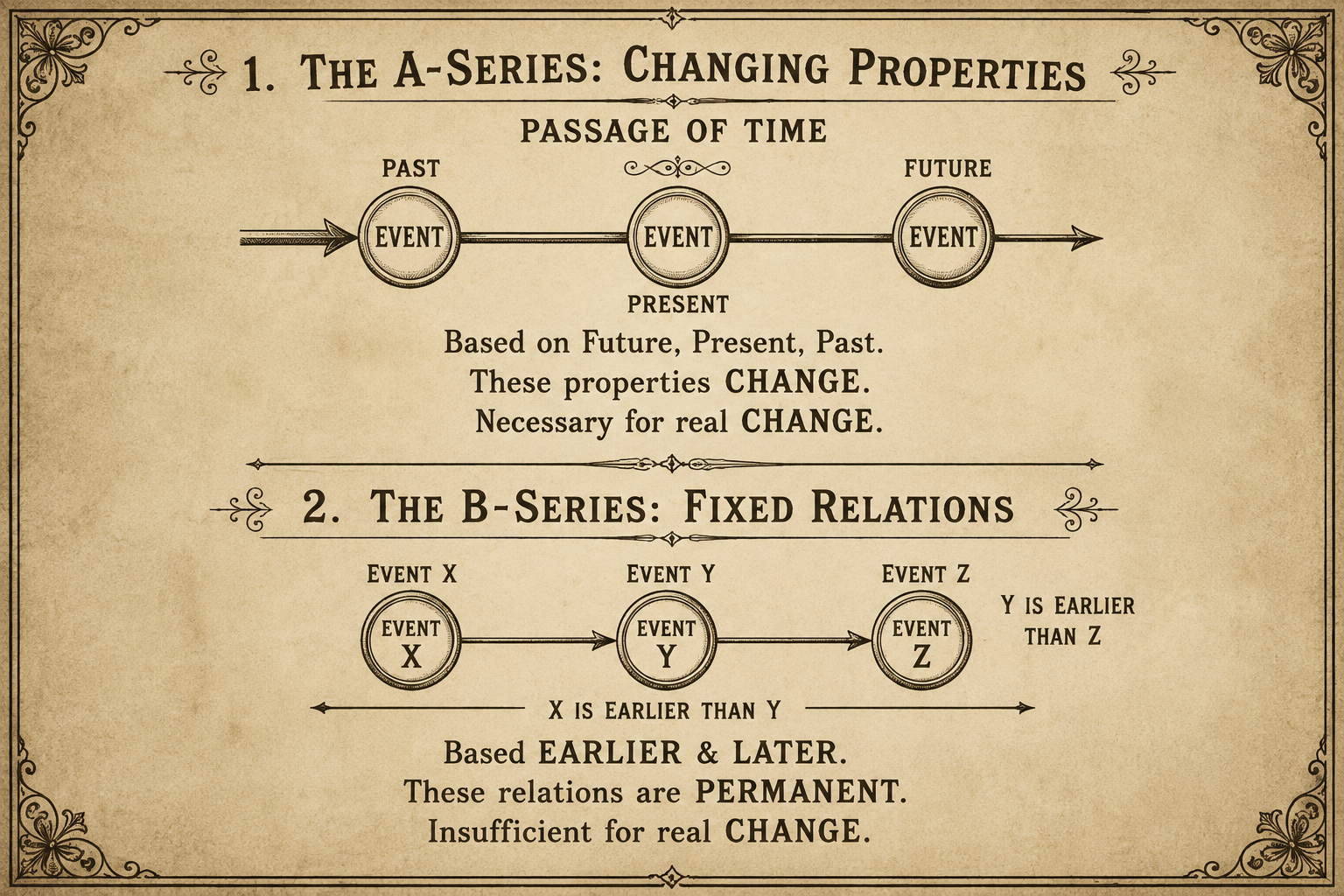
Figure 3. McTaggart's distinction between A-series and B-series.
McTaggart's ideas initiated a whole series of idealist conceptions regarding the nature of time and the existence of objective reality within it. The fundamental ontological question concerning time asks whether the property of being past, present, or future determines an object's existence.
Presentism asserts that, necessarily, only objects that are currently present exist; therefore, a complete list of existing things would exclude all merely past objects (like Socrates) and merely future objects.
In contrast, Eternalism is the non-presentist view that objects from the past and the future exist now in a general ontological sense, even if they lack present temporal location.
A third stance, the Growing Block Theory, is a non-presentist view that posits that only past and present objects exist, constantly expanding the realm of reality as time progresses. Both Presentism and the Growing Block Theory align with the A-theory of time (which emphasizes temporal passage), while Eternalism typically aligns with the B-theory (which emphasizes fixed, earlier-later relations). However, Presentism faces significant philosophical challenges, particularly in accounting for meaningful talk about non-present entities (e.g., referring to Socrates) or explaining truth-makers for past and future truths (e.g., that there were dinosaurs). Ultimately, this debate addresses whether temporal location affects ontology, maintaining a core tension in the philosophy of time. (Emery 2024)
The dispute between Eternalists and Presentists, as well as McTaggart's conception issue, can be resolved if we reject the idea of time having an objective existence independent of human consciousness.
When McTaggart says that there cannot be a time that is simultaneously past, present, and future because this is incompatible, his error begins with the words "a time that is," because time does not exist in reality; it exists only in the human imagination, and is an integral and crucial component of it. This implies that the past, present, and future do not exist objectively and independently of humanity as elements of physical reality, but are instead mental constructs that help a person comprehend the surrounding reality and organize their life. Just as Mach stated that absolute space and absolute motion are "pure things of thought, pure mental constructs, that cannot be produced in experience," the same applies to time. The future becomes the present, and then the past, not by virtue of some unknown physical principles, but only because we name them as such in our subjective conceptions.
If time does not exist in an objective sense, the disputes between Eternalists and Presentists lose meaning.
If, from the Presentist perspective, only the present is real, and the past and future do not exist in reality, this is true because the past and future exist not in reality, but in our imagination. But the present is also a mental construct, as we recall from Einstein's theory of relativity that it is impossible to synchronize distant clocks so that they show the same time.
If, from the Eternalist perspective, the reality of the past and future exists, it exists only in our imagination or fantasy (for the future) or memories (for the past).
So, if time is a socio-cultural phenomenon, it logically follows that it exists within the dominant cultural mindsets.
How time became metamodern
The phenomenon of time, apart from our consciousness, does not exist outside the medium that transmits it, even if that medium is a leaky coconut shell. That is why, to understand how time has changed from ancient times to the present, it is important to trace the evolution of these media.
In the premodern era, private clocks did not exist or were very rare, so people learned the time from the large clock on the city tower or from the cathedral’s bell, both of which embodied the power of government and faith in God. If you didn’t hear the bells or see the clock, all you could rely on was the rooster’s crowing, which never truly knew the hour. Accurate knowledge of time was a privilege of wealthy city dwellers, who used it to maintain their prosperity.
Modernity not only made wristwatches popular, but also introduced many alternative means of tracking and recording time. Now time could be learned from radio signals and newspapers. However, you still could not know the time instantly: you had to wait for the time signals, broadcast once an hour. After the exact time signal, listeners were offered the latest news, which was meant to teach them how to think correctly. The radio was always a voice governing citizens on behalf of the government.
Postmodern time arrived with television, which soon became multi-channel. Time appeared more frequently on screen, sometimes constantly during certain broadcasts. Along with time, viewers received a great deal of knowledge they didn’t really need, as they watched television indiscriminately for hours. Under these conditions, even if television was strictly controlled by the government, the sheer abundance of moving images and stories already undermined this control.
Metamodern time began with cheap smartphones, which guaranteed 24/7 inexpensive access to the Internet. An estimated 5.5 billion people are online in 2024, an increase of 227 million individuals based on revised estimates for 2023, according to new figures from the International Telecommunication Union (ITU 2024). This phenomenon is simply unprecedented in the history of all mankind, as a significant number of people constantly look at the clock throughout the day and coordinate their daily activities with it.
In this context, it is very interesting how the images of old media have evolved, as they were previously the only sources for communicating the time. Cathedral bells have either become tourist attractions or apocalyptic symbols, as in László Krasznahorkai's novel, Sátántangó.
“Futaki woke to hear bells. The closest possible source was a lonely chapel about four kilometers southwest on the old Hochmeiss estate but not only did that have no bell but the tower had collapsed during the war and at that distance it was too far to hear anything”. (Krasznahorkai 1985)
The bell in the final scene of Krasznahorkai's Sátántangó “suggests that the world we’re seeing turns on a contradiction between the materiality–the almost painfully exact rendering of the physical, the concrete, the particular…–and something mysterious and unaccounted for, an essence, perhaps spiritual, conspicuous by its absence". (Vickers 2019) There can be various versions here, as the interpretations of an artwork are unlimited, but the reminder of the immaterial nature of time, its existence only in the human consciousness (because only Futaki hears the bell), seems the most relevant.
Metamodern time has many characteristic features that have already been noted and described in numerous studies. In Douglas Rushkoff's book, Present Shock:
When Everything Happens Now (Rushkoff 2013), five characteristic features are presented, with a separate chapter dedicated to each.
1. Narrative Collapse
This concept of Narrative Collapse describes the breakdown of traditional, linear storytelling in media, culture, and politics. Old narratives that gave meaning, direction, and structure are replaced by fragmented, present-focused experiences. In a world saturated with instantaneous information and reality TV, the comfort of stories with beginnings, middles, and ends fades, leaving people trying to make sense of everything as isolated, immediate events rather than coherent narratives.
This collapse has only intensified with the spread of private news channels on social networks and messaging apps. News use across online platforms continues to fragment, with six online networks now reaching more than 10% weekly with news content, compared with just two a decade ago. Around a third of our global sample use Facebook (36%) and YouTube (30%) for news each week. Instagram (19%) and WhatsApp (19%) are used by around a fifth, while TikTok (16%) remains ahead of X at 12%. (Newman 2025)
According to a new study by the NGO "Internews-Ukraine," "Ukrainian Media: News Consumption and Trust in 2025," social networks have definitively established themselves as the main source of news for Ukrainians. The smartphone has become a "window to the world of information" even for older segments of the population. 86% of Ukrainians get their news from social networks, and 37% use only them. 91% read news on their smartphones. (Internews-UA 2025)
A vivid example of narrative collapse in news consumption is the Russian messaging app “Telegram,” used for this purpose by 51% of Ukrainians (RG/EUAM 2025). Telegram’s advantage as a news source lies in its hybrid nature, which can confidently be called metamodern. Users can subscribe to unlimited channels, and their authors are not only (or even primarily) journalists or celebrities, but ordinary people who have found themselves in unusual circumstances and gained access to unique events. These individuals, who can be called “metanewsmakers,” record videos or photos from the scene and immediately post them to their channels, usually accompanied by very subjective comments. Metanewsmakers do not always publish their own videos; sometimes they share footage found on the smartphones of captured or deceased soldiers. Videos can also be staged, created using artificial intelligence. No rules or standards of journalistic ethics apply in this context. This contributes to the spread of rumors and conspiracy theories. Ukrainian media watchdogs attempt to address breaches of journalistic standards in Telegram channels, but these efforts yield no tangible results, since activity on Telegram is not regulated by anyone, and government agencies have no influence unless criminal laws are violated—only then can a channel owner be arrested, ceasing their channel’s operation either independently or at law enforcement’s request. The number of metanewsmakers increases daily. They produce such a volume of posts that Telegram channel audiences are literally in a hypnotic trance, consuming news for hours each day in an endless scrolling process. If previously news broadcasts aired at strictly scheduled times and one could say “evening news broadcast,” anticipating it at a set hour, now news consumption has become impulsive: readers can suddenly start reading news because they have two free minutes, receive a sound notification, or simply feel bored. Even elderly people now spend hours bed-rotting, endlessly scrolling through Telegram channels. This kind of media consumption starts to resemble an illness. Under these conditions, real media that operate by the rules and have expertise stand almost no chance of entering this stream—even if they have their own Telegram channels.
Metanewsmakers can be private, state-affiliated, or of a mixed hybrid nature. A vivid example of a hybrid metanewsmaker is the Telegram channel "MAGYAR," run by Róbert Bródi (callsign — Magyar), a Ukrainian citizen of Hungarian origin. He is the commander of Ukraine’s Drone Systems Forces and the organizer and head of the Ukrainian Armed Forces’ aerial reconnaissance unit “Magyar’s Birds”. The channel features a series of drone footage showing the destruction of Russian occupation army equipment and personnel. Currently, the "Magyar’s Birds" unit eliminates up to 330 Russian soldiers per day. All confirmed kills are documented on video, with particularly noteworthy ones edited into compilations. The funniest moments are featured in a special segment called “Yoblyk of the Day.” (Yoblyk is a derogatory nickname for a Russian soldier.) Typically, the elimination of a Russian soldier involves 2–3 drones, so each subsequent drone records the target’s reaction to the strikes or what remains of their body. Sometimes short videos in this segment are titled, for instance, “A failed attempt to escape one’s own grave.” Videos from this segment receive tens of thousands of positive reactions and hundreds of enthusiastic comments.
Formally, these messages are news, but in essence they are not, because they do not report anything new, leaving the audience in a very characteristic state of metamodern flickering: they are simultaneously news consumers and spectators of a regular bloody spectacle that tempts and satisfies the desire for revenge, as happened historically during public executions in front of crowds in the city square. Narrative collapse means that now it is impossible to determine whether new media are telling any kind of story at all. Old mainstream media also offered a similar opportunity, but in a much more limited way, with constant debates about the ethical boundaries of showing death or brutality on screen. Now all these limitations have been lifted, except for conventional media, which have permanently fallen behind in this race.
2. Digiphrenia
Digiphrenia refers to how digital technology splits people between multiple roles, places, and timelines at once. Emails, texts, and constant online engagement force individuals to inhabit overlapping moments and identities — creating stress and confusion as personal coherence is disrupted. Time is no longer experienced sequentially but as a barrage of simultaneous demands from various sources and platforms.
Social Media Profiles & Simultaneous Identities: People maintain multiple social media accounts (Twitter, Facebook, Instagram, LinkedIn) and message feeds, each projecting a different version of themselves at the same time. This fragments their attention and identity, making it hard to be fully present in any one context.
Work-Life Overlap: Professionals juggle work emails, texts from family, social notifications, and news feeds all at once, even in supposedly “off” hours. The barrage of simultaneous demands disrupts personal focus, causing ongoing stress and blurring boundaries between roles.
Military Drone Operators: Rushkoff notes that drone pilots might control deadly machines on the other side of the world from behind safe screens — occupying contradictory moral and physical realities at the same time. They live in two places and two ethical worlds at once, enabled by digital mediation.
Constant Context Switching: People rapidly switch between open browser tabs, work chats, social notifications, and entertainment streams. This process (sometimes called “tab overload”) produces stress and cognitive exhaustion, as individuals fail to inhabit a single, continuous timeline or focus.
Dinner Table Distraction: Even in social situations like meals with friends or family, people are pulled away by notifications and engage absent-mindedly with smartphones instead of those physically present. “Digiphrenia” manifests in the habitual division of self between digital and real-world presences.
3. Overwinding: The Short Forever
Overwinding is the compression of long-term processes or goals into shorter time frames than they are meant for. In business and finance, this translates to the expectation of instant results, rapid trading, and immediate returns. The push to fit everything into the present moment, including processes that historically took years to mature, causes instability and a loss of long-term perspective.
Artificial intelligence tools have greatly accelerated this process. Now, people who don’t have time to read lengthy books of hundreds of pages can simply create a 2–3 page digest, compile a list of ten main points, or make a podcast. Then, new texts are generated based on these rapid digestions, which in turn are quickly read with ChatGPT or Perplexity. Eventually, the real authors and readers of texts become language models, while humans are left with only a general idea from brief summaries.
4. Fractalnoia: Finding Patterns in the Feedback
Fractalnoia describes the urge to find patterns and meaning in the overwhelming feedback loops of real-time information. With traditional timelines gone, people seek connections between events and data, sometimes inventing links where none exist. This can lead to paranoia or conspiracy thinking — or a networked sensibility, depending on whether the patterns are personal or shared.
5. Apocalypto
Apocalypto captures society's longing for finality or clear endings in a never-ending present. The persistent anxieties of living in "present shock" prompt fantasies of total collapse, reset, or apocalypse — responses to the stress of having no narrative resolutions or ultimate goals. This mindset manifests in prepping, fascination with doomsday scenarios, and apocalyptic media, as people look for closure amid chronic uncertainty.
The Netflix limited series Carol and the End of the World (2023) serves as an essential cultural artifact for mapping this Apocalypto metamodern temporality.
The series is set seven months before the rogue planet Keppler 9C is scheduled to collide with Earth, an event that frees most of humanity to embrace hedonism and pursue lifelong dreams, rendering jobs and money obsolete.

Figure 4. Mysterious rogue planet Keppler 9C is scheduled to collide with Earth.
Protagonist Carol Kohl, a quiet, middle-aged woman, is one of the few who feels lost by this newfound freedom and instead finds profound comfort in the monotony of her previous life. Her search for routine unexpectedly leads her to a secret, seemingly pointless office called "The Distraction," where she forms genuine human connections with other lost souls, finding meaning not in grand adventures, but in the small, shared rituals of a normal workday before the inevitable end. The environment itself reflects a metamodern aesthetic of memory: the surviving fragments of the preceding epoch (the corporate infrastructure) are reinvested with new, sincere purpose.
The show’s central conflict between mass apocalyptic hedonism and Carol’s dedicated routine resolves in favor of the latter, affirming the cultural utility of informed naivety (Metamodernism 2015). Carol and her coworkers proceed as if the routine, the friendship, and the shared coffee matter, fully cognizant that these structures are ultimately doomed. This reconciliation of hope (sincerity) with detachment (irony) is the essence of the metamodern temporal strategy.
The rogue planet Keppler 9C, this gigantic, celestial object is not just a threat; it is a static image of the future catastrophe. It is fixed, terrifying, and omnipresent. (Zeoli 2024) This functions as a crystal-image where the banal, slow present (Carol pouring coffee, doing paperwork) is simultaneously juxtaposed against the fixed, certain reality of its inevitable, violent end. Because the end is mathematically assured and visually constant, linear cause-and-effect (the need for immediate movement or survival) collapses. What remains is a pure duration, focusing the viewer and the characters entirely on the quality and authenticity of the present moment, thereby producing the specific affective aesthetics of metamodern temporality.
Against the backdrop of societal chaos and maximalist despair, the protagonist, Carol Kohl, embodies the metamodern counter-response: the construction of genuine meaning through intentional routine and structure.
Episode 6, "Holidays," perfectly encapsulates the metamodern temporal paradox. The characters consciously organize and celebrate future holidays—such as Christmas, birthdays, and Halloween—that are guaranteed not to arrive before Keppler 9C crashes. (Zeoli 2024)
This is a definitive act of temporal oscillation. The Ironic Pole (Postmodern knowingness) acknowledges that these traditions are meaningless rituals, as their scheduled purpose in linear time (e.g., Christmas in December) has been destroyed by extinction. Yet, the Sincere Pole (Modernist commitment to ritual) involves performing the celebrations anyway, accessing the deep, collective emotional meaning (affect) associated with community and shared tradition. (Zeoli 2024) By celebrating a future that cannot arrive, the characters perform an
intentional collapse of linear time. The past meaning of the holiday and the certainty of its future absence coexist simultaneously to enrich the fleeting present. The temporary community formed during these rituals grants immediate, authentic temporal value where none structurally exists.
In a world where time is endlessly mediated and exploded, the individual no longer simply inhabits a timeline but becomes an editor—curating memories, reactions, rituals, and micro-narratives across devices and media. Identity is forged from assembling these fragments into a livable present as time is only a fruit of our imagination.
Bibliography
Britannica 2025: “Time.” In Encyclopaedia Britannica. Last updated September 14, 2025. https://www.britannica.com/science/time Accessed October 7, 2025. Britannica 2025, 2:“12-Hour Clock.” Encyclopædia Britannica. https://www.britannica.com/topic/12-hour-clock. Accessed October 12, 2025.
Clocks Market Share 2025: Global Watches and Clocks Market Share 2025, Forecast To 2034. The Business Research Company. https://www.thebusinessresearchcompany.com/market-insights/watches-and-cloc ks-market-overview-2025. Accessed October 7, 2025.
Dictionary 2012: The American Heritage Dictionary of the English Language (Fourth ed.). 2011. Archived from the original on 19 July 2012.
Emery 2024: Emery, Nina, Ned Markosian, and Meghan Sullivan, "Time", The Stanford Encyclopedia of Philosophy (Fall 2024 Edition), Edward N. Zalta & Uri Nodelman (eds.), Last updated Fall 2024. https://plato.stanford.edu/archives/fall2024/entries/time/ Accessed October 12, 2025.
Fisher 1748: Fisher, George (accomptant). The Instructor: or, Young Man's Best Companion. Containing, spelling, reading, writing, and arithmetick, in an easier way than any yet published;... To which is added, the family's best companion:... and a compleat treatise of farriery;... 1748. Available at: https://archive.org/details/bim_eighteenth-century_the-instructor-or-youn_fisher-ge orge-accompta_1748/page/23/mode/2up.
Galison 2003: Galison, Peter. Einstein's Clocks and Poincaré's Maps: Empires of Time. New York: W. W. Norton & Company, 2003.
Graff Diamonds Hallucination 2025: $55 Million Quartz Watch. A Blog to Watch. https://www.ablogtowatch.com/graff-diamonds-hallucination-55-million-dollar-quar tz-watch/. Accessed October 11, 2025.
Guinness 2016: Guinness, Os. Impossible People: Christian Courage and the Struggle for the Soul of Civilization. InterVarsity Press, Downers Grove, 2016.
Internews-UA 2025: Ukrainian Media: News Consumption and Trust in 2025. Internews Ukraine. https://internews.ua/media-research. Accessed October 7, 2025.
ITU 2024: International Telecommunication Union. “Global Internet use continues to rise but disparities remain.” ITU Press Release, 27 November 2024. https://www.itu.int/en/mediacentre/Pages/PR-2024-11-27-facts-and-figures.aspx
Krasznahorkai 1985: Krasznahorkai, László. Sátántangó. Translated from Hungarian by George Szirtes. New Directions, 2012. Originally published in Hungarian in 1985 by S. Fischer Verlag, Frankfurt.
Lec 1972: Lec, Stanisław Jerzy. Myśli nieuczesane. Kraków: Wydawnictwo Literackie, 1972.
Mach 1960: Mach, Ernst (1960). The Science of Mechanics: A Critical and Historical Account of Its Development, 6th ed. Translated by T. J. McCormack. LaSalle, Illinois: Open Court.
McTaggart 1908: McTaggart, J. M. Ellis, 1908, “The Unreality of Time”, Mind, 17(4): 457–474. Reprinted in Le Poidevin and McBeath 1993: 23–34. doi:10.1093/mind/XVII.4.457
McTaggart 1921: McTaggart, John McTaggart Ellis (1921). The Nature of Existence. Vol. 1. Cambridge: The University Press.
Metamodernism 2015: Metamodernism: A Brief Introduction. metamodernism.com, January 12, 2015. https://www.metamodernism.com/2015/01/12/metamodernism-a-brief-introductio n/. Accessed October 13, 2025.
Navigation and Time 2025: “Navigation and Time.” The Saint-Malo Shipwrecks (Archeologie.culture.gouv.fr). https://archeologie.culture.gouv.fr/epaves-corsaires/en/navigation-and-time. Accessed October 12, 2025.
Newman 2025: Newman, Nic. Overview and key findings of the 2025 Digital News Report. Digital News Report 2025. Reuters Institute for the Study of Journalism, University of Oxford (Online Report, URL: https://reutersinstitute.politics.ox.al.uk/digital-news-report/2025/dnr-executive-sum mary), 2025.
Oxford 2025: Oxford English Dictionary. “Time.” In Oxford Advanced Learner’s Dictionary. https://www.oxfordlearnersdictionaries.com/definition/english/time_1. Accessed October 7, 2025.
Raybeck 1992: Raybeck, Douglas. The Coconut-Shell Clock: Time and Cultural Identity. Time & Society, vol. 1, no. 3, 1992, pp. 323–340. SAGE Publications (London, Newbury Park, and New Delhi).
RG/EUAM 2025: RG EUAM Report, August 2025. https://cdn.prod.website-files.com/685c279caf66f4023ad2cab4/68d520ca901d40 677cdcdab4_RG_EUAM_082025_UA_fin_compressed.pdf. Accessed October 7, 2025.
Rushkoff 2013: Rushkoff, Douglas. Present Shock: When Everything Happens Now. Current, a member of Penguin Group (USA) Inc. (New York), 2013.
Vickers 2019: Vickers, Jon. “Those Bells.” Establishing Shot – IU Blogs. December 4, 2019. https://blogs.iu.edu/establishingshot/2019/12/04/those-bells/
Washington Times 2025: Big Ben Clock Tower Restoration Doubles Cost, Wins Critical Acclaim. The Washington Times. https://www.washingtontimes.com/news/2025/sep/4/big-ben-clock-tower-restorati on-doubles-cost-wins-critical-acclaim/. Accessed October 12, 2025.
Zeoli 2024: Rowan Zeoli. “Carol & The End of the World” Teaches Us How to Survive the Apocalypse. Autostraddle, February 1, 2024. https://www.autostraddle.com/carol-and-the-end-of-the-world-queer-community/ . Accessed October 13, 2025.