The Faces of War: How Cinema Shapes and Distorts Historical Memory in Ukraine
(Article for "Kino-Kolo" magazine, 24 1 (39) "Ukraine on Fire")
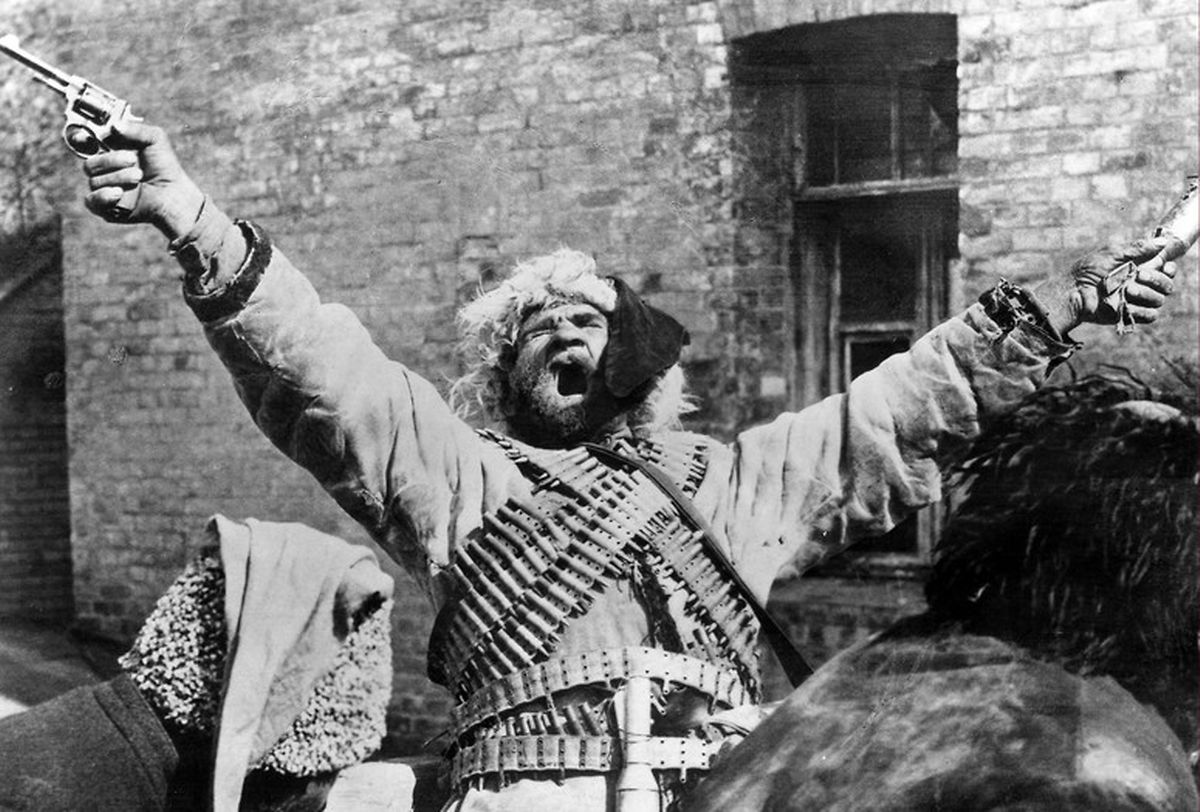
Every war has its own face, formed by millions of faces of its participants. All of them eventually become the faces of characters in films about war, and the expressions of these faces—emotions, gazes, gestures—personify these tragic events in history for us. No one knows how everything actually happened, so acting becomes a substitute for real memories. If an actor possesses an expressive appearance and performs convincingly, their portrayal can overshadow the memories of real events and create a "real" reality, which can be used for propaganda if the film's producers so desire.
This assertion is best illustrated by the performance of Semen Svashenko (Tymosh) in Oleksandr Dovzhenko's film “Zvenyhora” (1928). Dovzhenko, a committed communist and Russian imperialist who adapted his views to save his life and win favor with the Moscow leadership, discarded the typical red propaganda poster that aimed to brand “Ukrainian bourgeois nationalism,” ridicule the Ukrainian People’s Republic, and forever unite thoroughly Russified Ukrainians with Moscow Bolshevism. This stance led to a conflict with the scriptwriters, Mykola (Mike) Johansen and Yuriy Tyutyunnyk.
Dovzhenko recounted their reaction in his 1939 autobiography:
“The script contained a lot of nonsense and clear nationalist tendencies. That’s why I revised it by 90 percent, resulting in the authors demonstratively ‘removing their names,’ marking the start of my disagreement with the Kharkiv writers.”
At the meeting of Ukrainian writers convened by VUFKU (All-Ukrainian Photo Cinema Administration) on September 13–14, 1928, Johansen also expressed his position of disagreement with the production of films saturated with propagandistic communist undertones:
“Of course, we need to produce more films with our Soviet content, but of the type that American films were. And in this regard, there are none. It’s not for me to tell you which films the proletariat loves the most, but this gap is not only remaining unfilled, but there is even an avoidance of it, and there is a danger of the demise of artistic films.”
Consequently, the authors of the "wrong" script, Johansen and Tyutyunnyk, were executed, while Dovzhenko received the Order of Lenin, two Stalin Prizes, and one Lenin Prize.
In this film, Semen Svashenko plays the role of communist Tymosh, whose brother Pavlo, a petlyurivets1, flees to Prague after the collapse of the Ukrainian People's Republic, leading a miserable and absurd life, constantly attempting suicide.
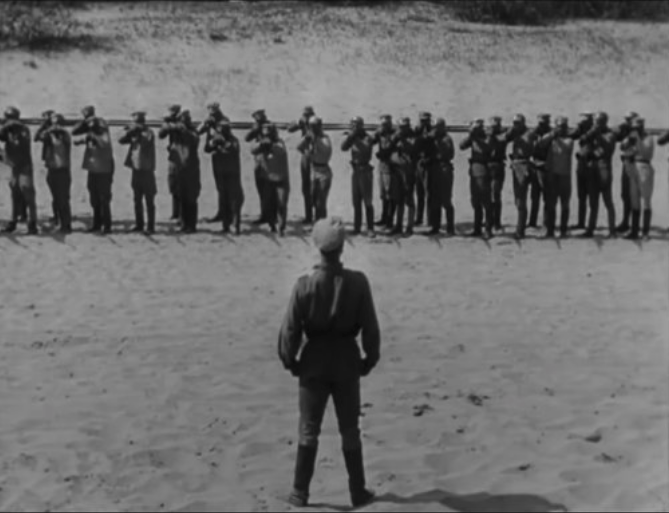
Tymosh commands his own execution. Screenshot from Oleksandr Dovzhenko's film “Zvenyhora” (1928).
Dovzhenko clearly mocks the UPR, striving to trample its legacy into the dirt. Interestingly, there was a significant diplomatic presence of the UPR in Prague at that time, which likely bothered loyal Leninists.
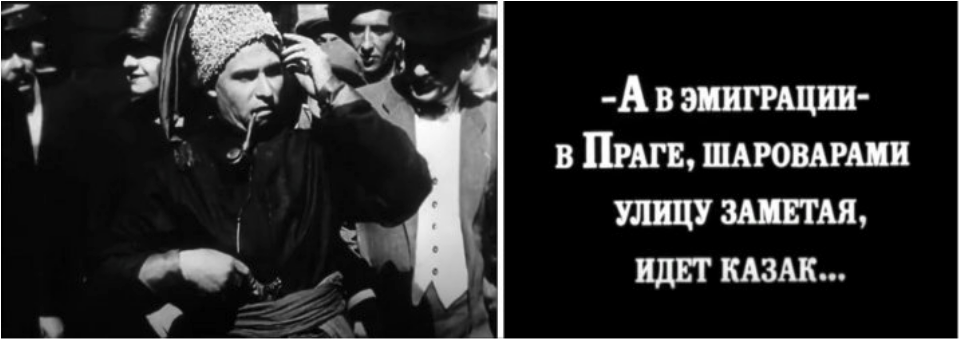
“And in emigration, in Prague, sweeping the street with his wide trousers, walks a cossack…” A screenshot from Oleksandr Dovzhenko's film “Zvenyhora” (1928).
Since the film is silent, the actors must compensate for the lack of dialogue with emphatic theatrical expressions and strike poster-like, even comical poses. Semen Svashenko frequently flashes his eyes and makes tense gestures with his hands, reminiscent of a worker on a modern automobile assembly line.
This is particularly evident in scenes depicting World War I, when he ventures into German trenches with his bare hands or commands his own execution.
The talented actor Amvrosiy Buchma also devoted his talent to Moscow propaganda. In one of his early films, McDonald, he ridiculed the "decaying West," and in The Feat of a Scout, which greatly pleased Stalin, he portrayed a submissive Little Russian, agronomist Leshchuk.
After his arrest, an enraged German occupier interrogates him:
“Ukrainian or Russian?”
“In this case, it doesn’t matter... Well, a Ukrainian,” he replies.
Buchma was a leading actor in the famous "Berezil" theater, an agent of the Cheka2, and received the Order of Lenin and two Stalin Prizes.
However, it is important to note that Buchma occasionally displayed vivid human emotions. Notably, his three-minute role as a gasping German soldier in Dovzhenko’s powerful expressionist film “Arsenal” is striking. This crazed, dying laughter, with an open mouth where half the teeth are missing, appears grotesque and especially haunting in context: it seems that death itself is mocking.
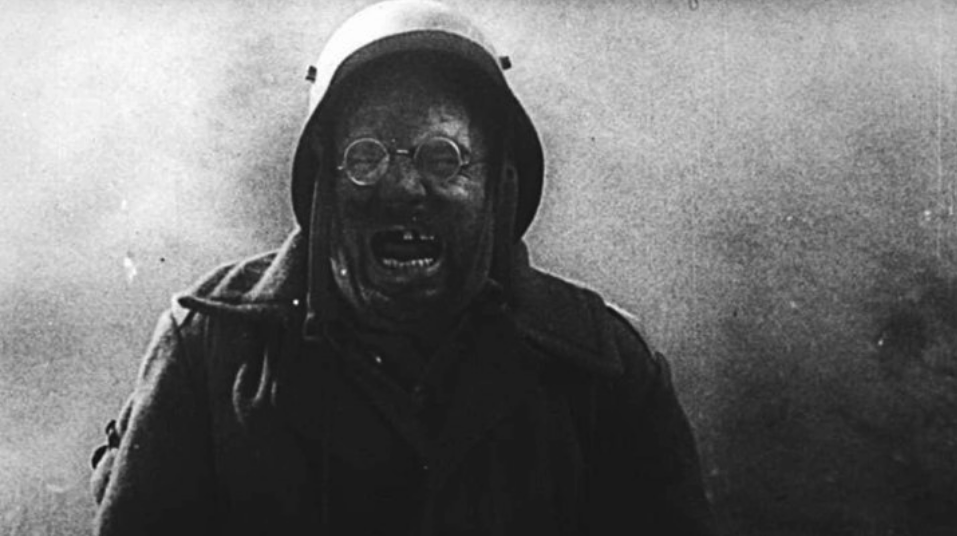
Amvrosiy Buchma as a German soldier in Dovzhenko’s film “Arsenal” (1929).
Nataliya Uzhviy received the Order of Lenin for her role as partisan Olena Kostiuk in Mark Donskoy's film “The Rainbow” (1943). Once captured by the enemy, she faces a harrowing choice:
The Nazis will either execute her newborn child or she must betray her fellow partisans.
as a partisan Olena Kostiuk Nataliya Uzhviy as a partisan Olena Kostiuk in Mark Donskoy's film “The Rainbow” (1943).
Olena chooses loyalty to her comrades. Was it really like that? How did real women behave in such situations? We don’t learn this from “The Rainbow”, yet Nataliya Uzhviy's portrayal is so convincing—full of pathos and emotion—that viewers instantly believe her dedication to Lenin.
In this film, the Germans are caricatured as cruel, speaking Russian with a comical German accent, while Olena Kostiuk’s Russian is always flawless. We are led to believe that she is prepared to sacrifice her child for the USSR's victory in World War II.
In his book “Cinema and Radio Propaganda in the Second World War”, researcher Kenneth Short noted that “The Rainbow” became:
“The most potent and effective example of Soviet propaganda throughout the war.”
The American ambassador in Moscow personally recommended the film to US President Franklin Roosevelt for viewing. Consequently, it was honored with:
- The Grand Prize from the Association of Film Critics of the United States
- The Supreme Award from the Daily News for the best foreign film at the American box office in 1944
- A prize from the National Council of Film Critics
Ivan Mykolaichuk not only starred as Petro, the son of the musician Dzvonar, in Yuriy Illenko's film “The White Bird Marked with Black” (1971), but also co-authored the screenplay for this remarkable film.
The story unfolds from 1937 to 1947 in Bukovina, during which Romania lost this territory to Soviet Ukraine. Illenko's film stands out from most other films of its time, not only for its complex and original imagery but also for employing the Ukrainian language in its dialogues.
However, the language retains a strong local West-Ukrainian accent, making parts difficult to understand. It avoids the simplistic slogans typical of propaganda. Yet, political themes do permeate the film.
Petro (Ivan Mykolaichuk) fights with a Hutsul-UPA3 member because the latter supports Hitler, while Petro’s father has kissed the hand of a Soviet commander.
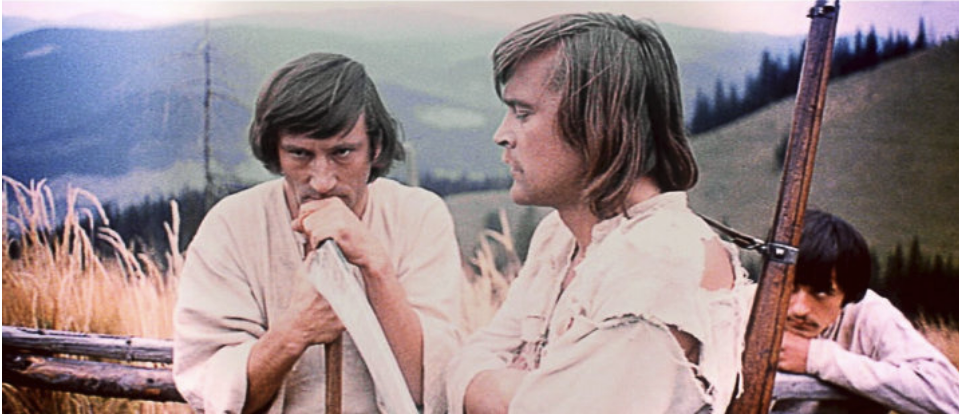
Ivan Mykolaichuk (in profile) as Petro, the son of the musician Dzvonar in Yuriy Illenko's film “The White Bird Marked with Black” (1971).
Unsurprisingly, the son of the Dzvonar soon enlists in the Red Army, albeit not out of communist zeal; rather, his choice stems from a premonition of Nazi defeat. Meanwhile, Petro’s brother, Orest, has joined the UPA, leading to a tragic conflict within the Dzvonar family.
Mykolaichuk successfully crafts a complex and contradictory character, making this film timeless, unlike Mykolaichuk's brief appearance in the TV series “Liberation” (artilleryman Savchuk, part one “The Arc of Fire”, 1968).
In a brief scene, Ivan Mykolaichuk takes aim at advancing German tanks but is shot in the head and collapses. Russian captain Serhiy Tsvetaev (Mykola Olyalin) quickly takes his place, and a moment later, the tank destroys the artillery unit.
A dazed Savchuk then cries out with an obvious Ukrainian accent:
“Comrade captain, there are five shells left!”
Later, a nurse in love with Tsvetaev rushes onto the battlefield.
And where is Savchuk?
This no longer concerns anyone; he has merely served as an inconspicuous backdrop for the heroic Russian captain.
Interestingly, Russian actor Mykola Olyalin, who portrayed Tsvetaev, transitioned into a Ukrainian actor that same year.
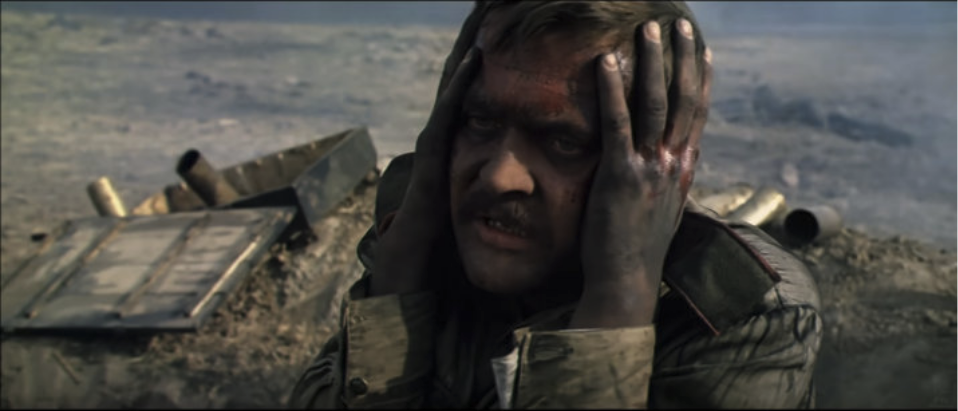
Ivan Mykolaichuk as artilleryman Savchuk in Yuri Ozerov’s TV series “Liberation” (1968).
Though he spoke no Ukrainian, he starred in Dovzhenko Film Studio projects, performed at Ukrainian cultural venues, received the Order of Prince Yaroslav the Wise, earned the title of People’s Artist of Ukraine, was awarded a lifetime scholarship from President Viktor Yushchenko and buried at the Baikove cemetery4 in Kyiv.
However, "Ukrainization" did not stop Olyalin from participating in the chauvinistic series “Russian Project” (even acting alongside Nikita Mikhalkov, who holds a deep-seated hatred for Ukraine), which contributed to the rise of revanchism and militarism in Russian society, ultimately culminating in war.
Leonid Bykov's role as Captain Oleksiy Tytarenko, nicknamed Maestro—the commander of the second squadron—in the Soviet cinematic masterpiece “Only Old Men Are Going to Battle” (1974) occupies a special place among Ukrainian film actors.
Bykov also directed this film, allowing himself liberties that might not have been well-received even in the USSR of 1974.
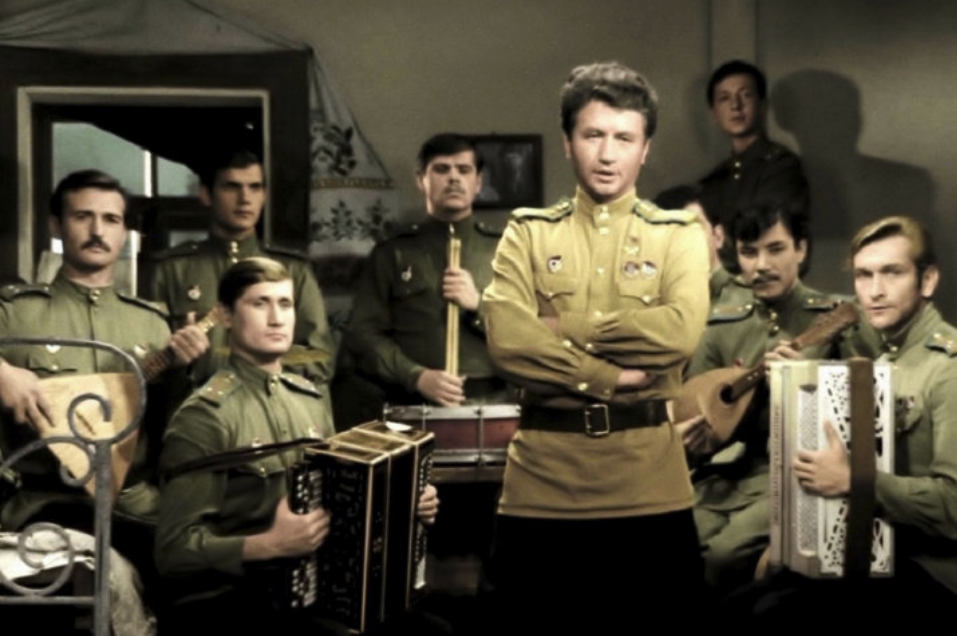
Leonid Bykov portrays Captain Oleksiy “Maestro” Tytarenko in “Only Old Men Are Going to Battle” (1974).
His monologue:
“How did you not notice? We fought over my Ukraine today!”
marks a pivotal moment—for the first time in Soviet cinema, Bykov portrays an active, charismatic, witty, and even cheeky Ukrainian in a way that is difficult for us to appreciate today.
Notice how he responds with:
“You are welcome!”
in Ukrainian instead of Russian.
In this context, these Ukrainian words do not convey gratitude but sound almost like an insult.
Unfortunately, this talented film has become one of the brightest examples of the so-called “Soviet heroic narrative”, which eventually paved the way for Russian aggression against Ukraine.
Underneath this film’s YouTube postings, many comments echo sentiments like:
“How clearly the unity of Soviet soldiers from different nationalities is depicted in the fight against fascism.”
Moreover, it is worth noting that the Ministry of Culture of the Ukrainian SSR attempted to ban the film.
Hleb Shandybin, the acting director of the Dovzhenko Film Studio, convinced the Head of State Cinema of the Ukrainian SSR, Vasyl Bolshak, not to create a Ukrainian dubbing for this picture (which was very unusual, because it was typically done), claiming:
“The theme of internationalism would disappear.”
Indeed, genuine internationalism appears to be possible only in the Russian language!
One should also make a separate observation. When analyzing 20th-century Ukrainian films, a palpable artificiality in restricting the Ukrainian language is evident:
If a film had potential for commercial success and broad distribution, it would likely exist exclusively in Russian.
The case of “After Two Hares” (1961) is telling, as it was filmed in Ukrainian but later translated into Russian when producers recognized its commercial prospects; consequently, the Ukrainian original was “lost” for 52 years, only to be found later in the Mariupol Film Fund.
This film storage, by the way, contained over 80 tons of unexamined film material, much of which was almost certainly lost forever due to destruction by Russian invaders in 2022.
The principle of restricting the Ukrainian language in cinema persisted well beyond the collapse of the USSR in commercial film production, only beginning to significantly decline in recent years.
After the USSR’s disintegration, actors, liberated from Soviet censorship and the burden of Russian imperialism, began to emerge in Ukraine, yet this did not resolve complex artistic challenges.
Hryhoriy Gladiy managed to appear in Leonid Bykov’s “Only Old Men Are Going to Battle” (as an unnamed technician of the “Colt,” Oleksandrov), but his most significant role was as Roman Shukhevych in Oles Yanchuk’s “Undefeated” (2000).
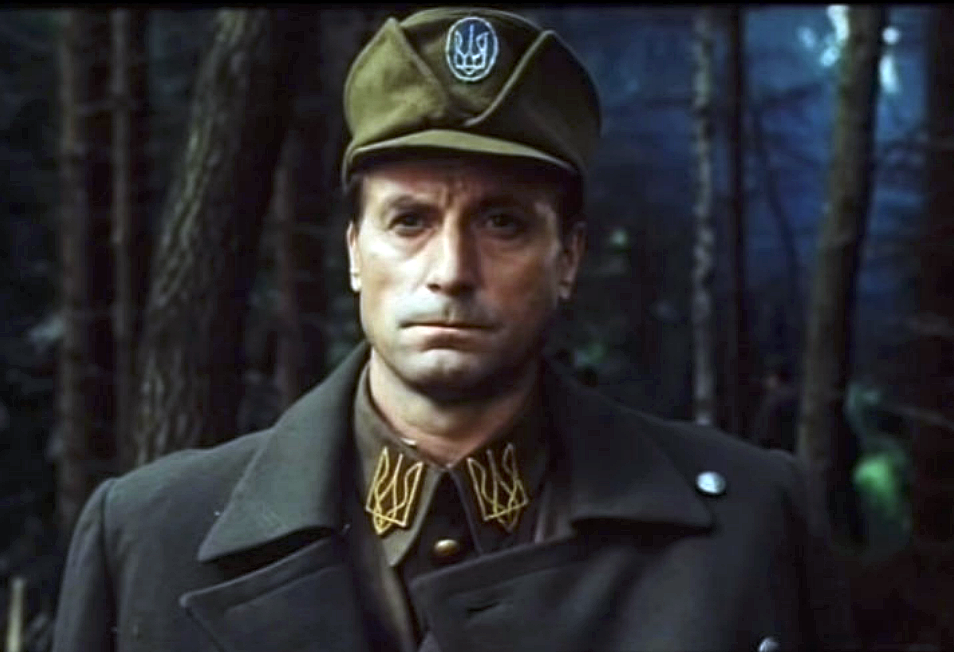
Hryhoriy Gladiy as Roman Shukhevych in Oles Yanchuk’s “Undefeated” (2000).
Unfortunately, despite the guidance of Askold Lozynskyi, president of the World Congress of Ukrainians, this film took a close-to-Soviet "realist" approach, lacking vivid artistic discoveries or compelling portrayals.
It resembles the uninspired productions of the Dovzhenko Film Studio in the 1970s.
The director, Oles Yanchuk, seems either to have avoided creative exploration and unconventional directorial decisions or simply may not have been familiar with them.
Hryhoriy Gladiy also fails to attempt to capture the complex character of Roman Shukhevych, merely moving through scenes and delivering sterile lines as written by a far-from-ideal script of a clichéd costume drama.
For effective artistic representation of historical events in film, it is insufficient to merely dress actors appropriately, provide them with fitting dialogue, and start filming.
The work of a true artist demands more; each project presents a challenging creative task without ready-made solutions, where no advice is universally valid, and no one is immune to mistakes or failures.
Conversely, Yevhen Lamakh, playing senior sailor Mishka in Timur Yashchenko’s “Cherkasy” (2014), achieved impressive results in understanding and portraying his character, despite his youth.
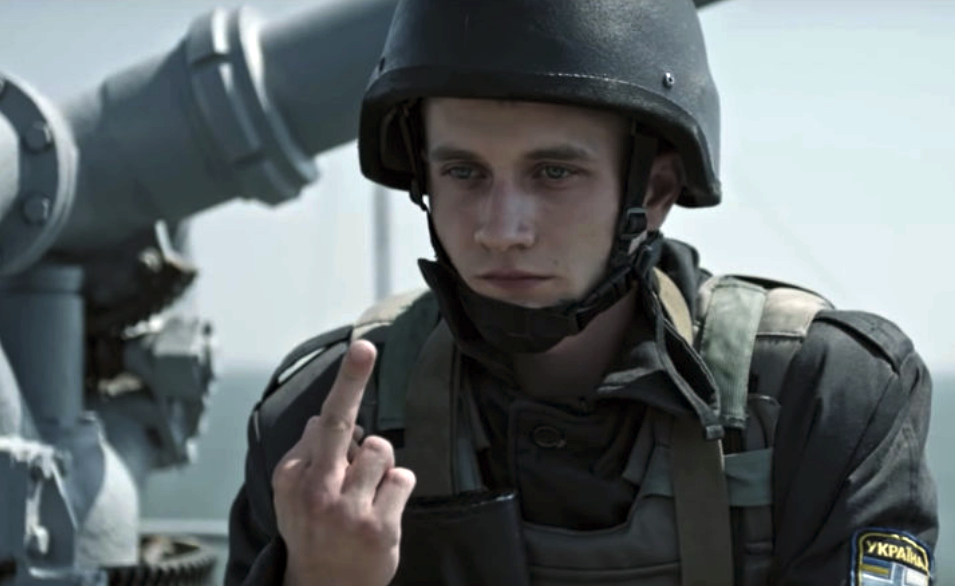
Yevhen Lamakh as a senior sailor Mishka in Timur Yashchenko’s “Cherkasy” (2014).
Mishko emerged as a complex and captivating figure:
- Initially presented as a thoughtless village hooligan drawn to the navy for its allure,
- By the end of the film, he transforms into a tragic hero from a nation that has chosen not to defend itself against Russian aggression in 2014.
Mishko becomes entwined in crucial historical events that shape his character.
Importantly, director Timur Yashchenko sidesteps excessive pathos and propaganda by showcasing the unpleasant aspects of daily life; each character in his film possesses flaws that balance their heroic portrayals.
Yevhen Lamakh also takes on a more ornamental role as student Andriy Savytskyi in Oleksiy Shaparev’s “Kruty 1918” (2019), which feels too ordinarily directed—akin to a costume drama where Kyiv students engage in artificial dialogues more suitable for puppet theater than for a story about Ukrainian heroes.
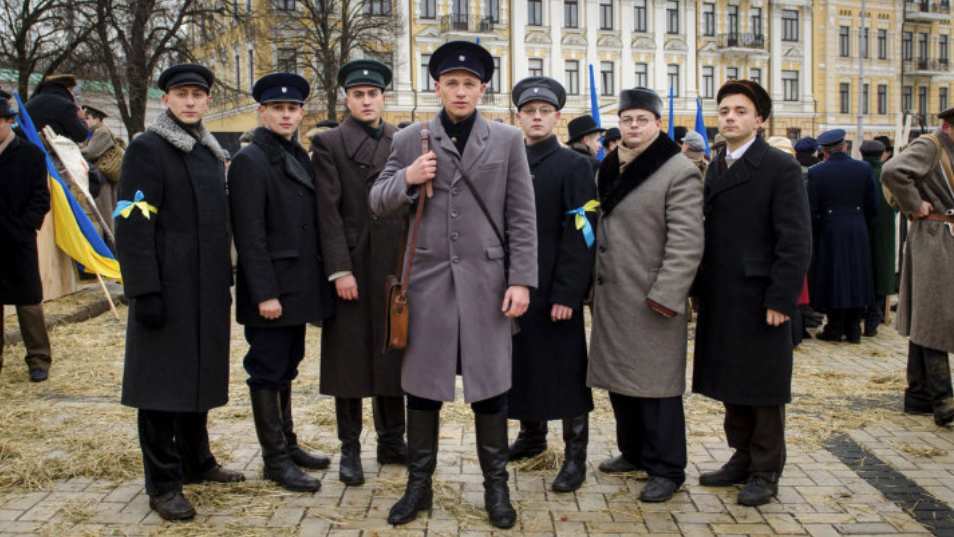
Yevhen Lamakh as a student Andriy Savytskyi in Oleksiy Shaparev’s “Kruty 1918” (2019).
Their lines appear as clumsy and forced as the French accents of counter-spies played by Ukrainian actors.
Oksana Cherkashyna portrays Tetyana, a combat medic hardened by the brutality of war, in Natalia Vorozhbyt’s “Bad Roads” (2020).
This film captivates with its unique and unprecedented precision in capturing on-screen events.
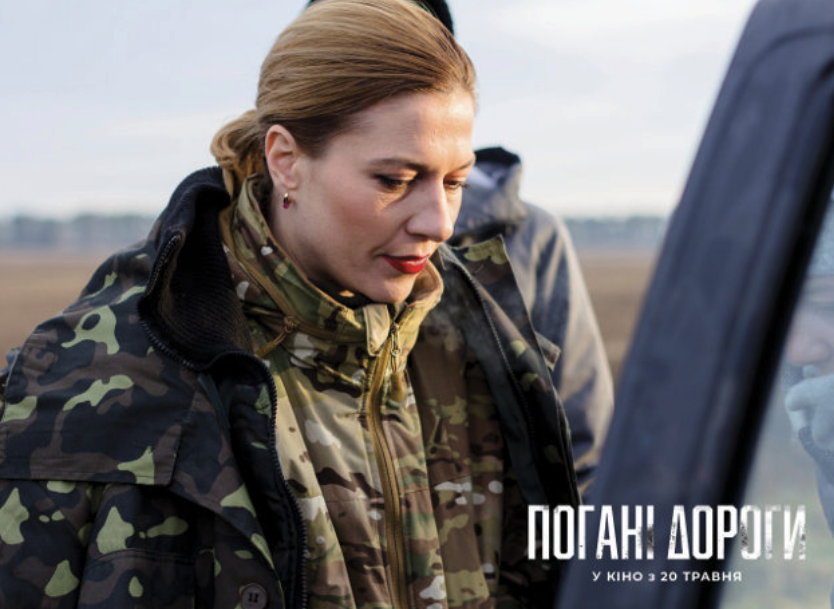
Oksana Cherkashyna as a combat medic Tetyana in Natalia Vorozhbyt’s “Bad Roads” (2020).
It feels as though the director timed every scene with a stopwatch during filming, with:
- Intricate angles
- Carefully crafted intonations
- Every dialogue serving the purpose of engrossing the audience
The audience almost feels submerged in the action.
For instance, during Tetyana’s poignant recollections about her deceased lover, the background of vulgar pop music makes her words feel much closer to reality.
It creates the impression that it is not Oksana Cherkashyna speaking, but rather, combat medic Tetyana, blurring the lines between performance and documentary.
A notably powerful moment occurs when she sings a banal yet melodramatic song by a Russian pop singer Tanya Bulanova—its unexpected presence within a film about wartime heroism is both poignant and artistically justified.
Marina Klymova also delivers a strong performance in the film as journalist Yulia, taken captive by the terrorist Stas.
In her portrayal, every line, exclamation, whimper, and sudden fainting spell is so calculated and precise that it resonates like a symphony.
Natalya Polovynka, cast as the mother of missing military pilot Sofia Kulyk in Zaza Buadze’s “Mothers of the Apostles” (2020), embodies the stereotypical image of a soldier’s mother at war, willing to do anything for her child.
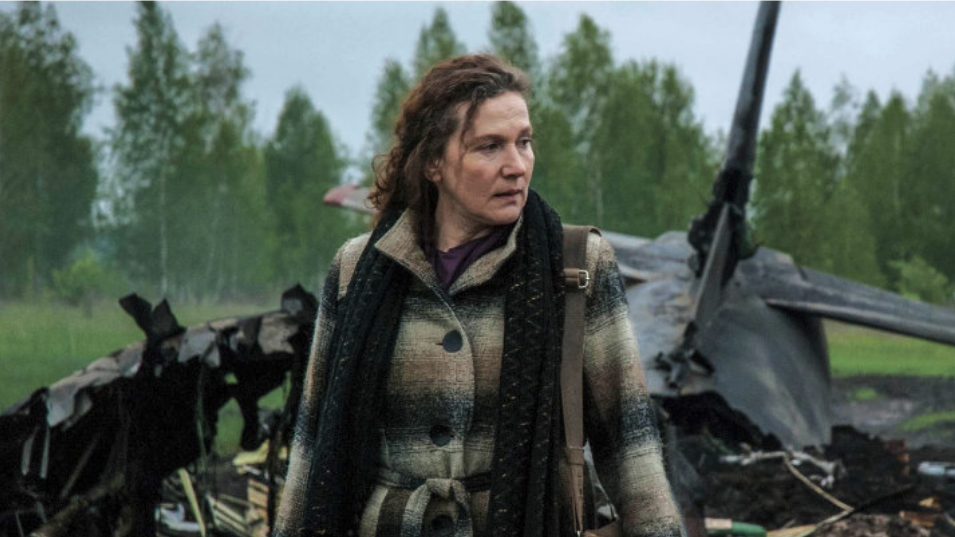
Natalya Polovynka as the mother of missing military pilot Sofia Kulyk in Zaza Buadze’s “Mothers of the Apostles” (2020).
Sofia ventures into occupied Donbas, where she encounters:
- Stereotypical terrorists
- A stereotypical alcoholic woman
- A stereotypical journalist on television
At one point, the viewer may feel as if they are not watching a film, but rather an engaging computer game titled “Survive and Escape from the DPR”5.
In this film, Natalya Polovynka does not act in the traditional sense; instead, she meticulously processes the script.
Director Buadze, primarily known for shooting TV commercials and shows—the commercial viability of which is built on rigid stereotypes—employs techniques designed to captivate viewers and, by extension, drive up advertising rates.
It is clear that he is selling this story to the audience using well-established commercial methods, and he succeeds, even if stereotypical art lacks high artistic merit.
It serves as a reflection of its time and can reveal fragments of truth about reality.
Comedian Heorhiy Deliev, in the role of terrorist Batianya (Pop) in Serhii Loznytsia’s “Donbas” (2018), proves to be quite organic.
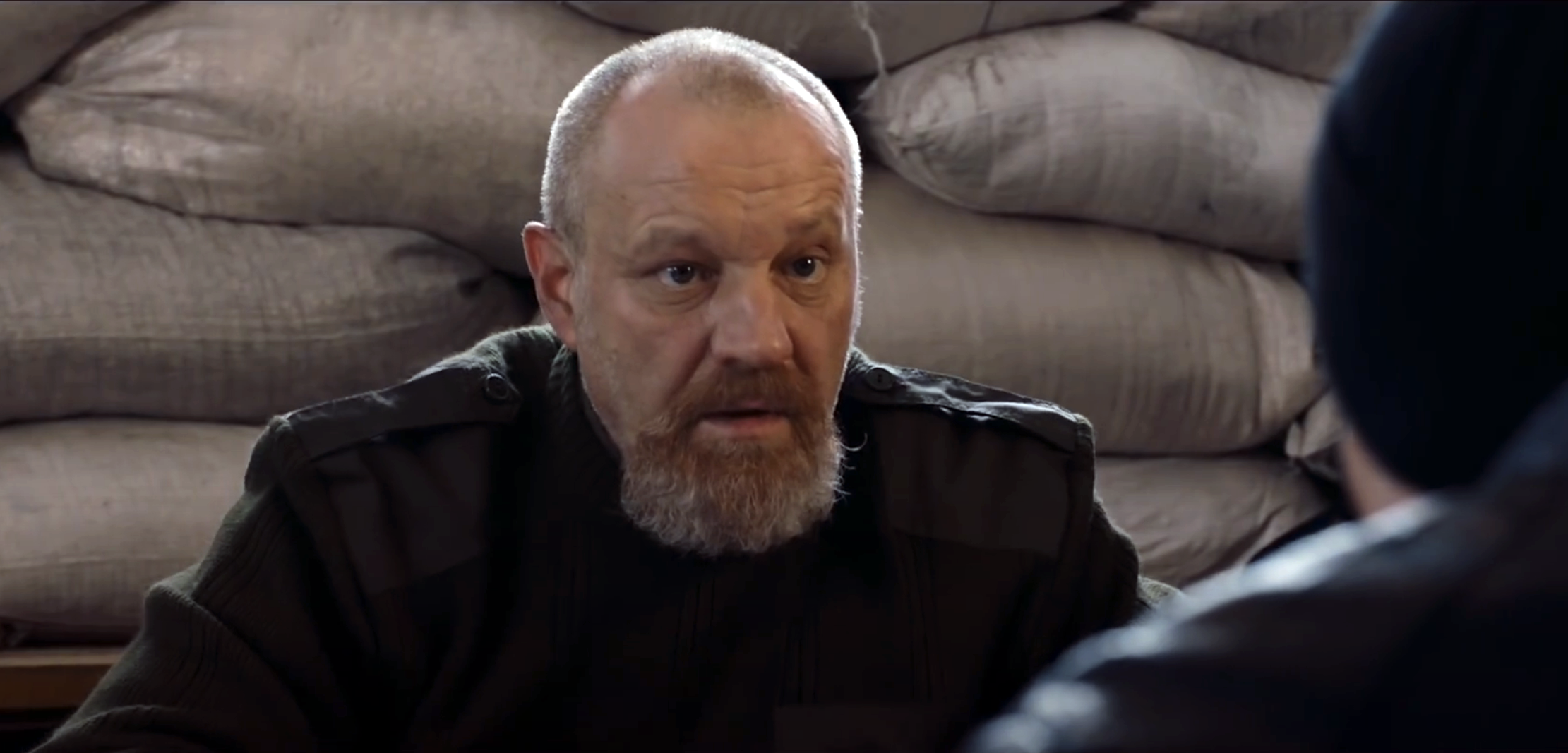
Heorhiy Deliev as terrorist Batianya (Pop) in Serhii Loznytsia’s “Donbas” (2018).
All the terrorists in occupied territories are, in essence, clowns, lending a circus-like atmosphere not only to this film but also to the documentary footage emerging from those regions.
The character of “a short-haired, bald man with a gray beard”, who persuades a businessman to give his car to the “rebels”, feels authentic in Deliev’s portrayal.
This is partly because director Loznytsia captures the tone of a tale that resembles a cruel and bloody circus staged on Ukrainian land occupied by Russians.
Vyacheslav Dovzhenko, as the commander of the Donetsk Airport6defense group with the call sign "Serpen" (August) in Akhtem Seitablaev’s “Cyborgs” (2017), faced the complex challenge of authentically representing a heroic struggle.
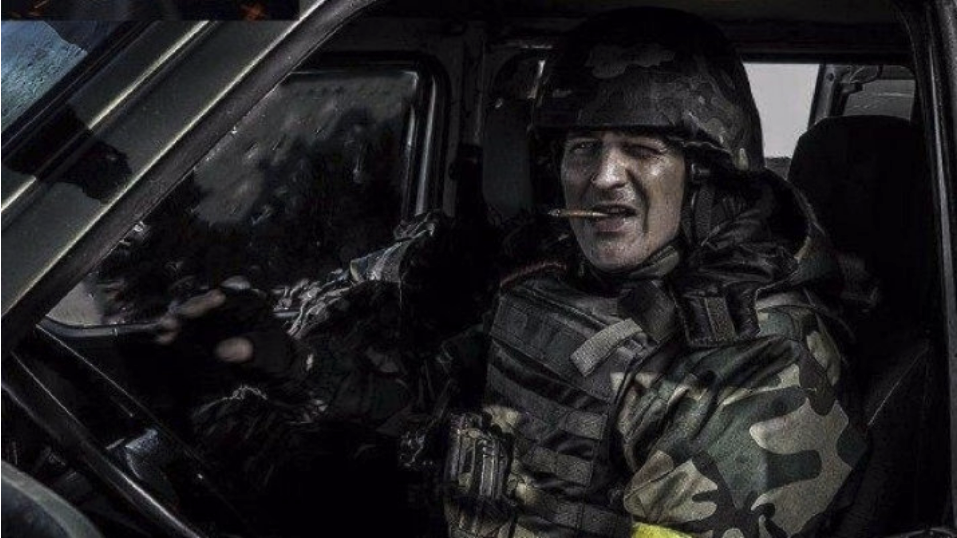
Vyacheslav Dovzhenko as the commander of the Donetsk Airport defense group in Akhtem Seitablaev’s “Cyborgs” (2017).
The challenge:
- Avoiding cheap and clichéd pathos.
- Portraying realistic modern combat.
- Balancing historical accuracy and dramatic tension.
Timur Yashchenko successfully overcame this difficulty in the “Cherkasy” movie by selecting the right cast and showing the characters’ disadvantages.
In contrast, Seitablaev opted for a “Counter-Strike” game-like style in his film.
This is evident in scenes featuring:
- Night raids and shootouts in dark corridors.
- Characters using thermal imaging to spot enemies.
However, Vyacheslav Dovzhenko delivers an important monologue:
“In this war, it is not enough to simply follow orders... we must think, love, feel injustice...
We are fighting not only against Russians and Kadyrovtsy7 but also against our very own Ukrainians...
We must study, know history, and analyze our mistakes.
If we are here, then we agree to pay for the past.”
This perspective is critical following many years of obedient state film propaganda, where everything was clear from the start.
A true film should:
✅ Challenge viewers’ beliefs
✅ Prompt doubt instead of blind trust
✅ Cultivate a critical view of reality
A scene in Seitablaev’s film could not have appeared in previous patriotic works:
When one soldier exclaims, “I love Ukraine!” another laughs loudly, sensing the falseness in the sentiment, quipping, “Propaganda in action!”
Previously, films could be labeled as:
- "Successful" propaganda
- "Less successful" propaganda
Now, for the first time, doubt is boldly articulated on screen:
Love for Ukraine may not be sincere but rather the result of propaganda.
Recognizing this marks a potential qualitative shift in the narrative of Ukrainian cinema.
Reality is intricate and multifaceted.
Adequately portraying it onscreen demands considerable effort, as seen in the works of the most renowned global metamodern artists.
We should anticipate that Ukrainian directors will also embrace this trend.
Footnotes
-
A follower or supporter of Symon Petliura, a prominent Ukrainian political and military leader during the Ukrainian War of Independence (1917–1921). Petliura was the head of the Ukrainian People's Republic (UPR) and a key figure in the struggle for Ukrainian independence after the fall of the Russian Empire. ↩
-
The Cheka (short for All-Russian Extraordinary Commission for Combating Counter-Revolution and Sabotage) was the first secret police organization established in Soviet Russia in 1917 under Vladimir Lenin. It was tasked with suppressing political opposition, counter-revolutionaries, and dissent during and after the Russian Revolution. The Cheka became infamous for its brutal tactics, including arrests, executions, and the use of forced labor camps. It was a precursor to later Soviet security organizations like the NKVD and the KGB. ↩
-
The Hutsuls are an ethnic subgroup of Ukrainians living in the Carpathian Mountains, primarily in western Ukraine. They are known for their distinct traditions, vibrant folk art, music, and unique dialect. The UPA (Ukrayins’ka Povstans’ka Armiya) was a Ukrainian nationalist military organization formed during World War II in 1942. Its primary goal was to fight for Ukrainian independence, resisting both Nazi Germany and the Soviet Union. The UPA used guerrilla warfare tactics and is controversial for its actions, including involvement in ethnic conflicts during the war. It remains a significant symbol of Ukrainian resistance and independence for many Ukrainians. ↩
-
Baikove Cemetery (Ukrainian: Байкове кладовище) is a historic cemetery memorial in Holosiivskyi District of Kyiv, Ukraine. It is a National Historic Monument of Ukraine and is known as a necropolis of distinguished people. ↩
-
Donetsk People's Republic (DPR or Донецька Народна Республіка in Ukrainian) is a self-proclaimed, unrecognized separatist entity established in 2014 in the Donetsk region of eastern Ukraine. Backed by Russia, the DPR played a central role in the war in Donbas and the ongoing conflict between Ukraine and pro-Russian forces. Ukraine and most of the international community consider the DPR an illegal entity operating under Russian occupation. ↩
-
Donetsk Airport became a symbolic and strategic focal point during the Ukrainian war in 2014-2015. It was fiercely contested between Ukrainian forces and Russian-backed separatists due to its strategic location and modern infrastructure. Despite being heavily damaged, Ukrainian soldiers, nicknamed the "Cyborgs" for their resilience, defended it for 242 days. The intense battles highlighted the broader struggle for control in Donbas and became a symbol of Ukrainian resistance. Ultimately, separatists captured the ruins in January 2015. ↩
-
The Kadyrovtsy are Chechen paramilitary forces loyal to Ramzan Kadyrov, the leader of Chechnya and an ally of Vladimir Putin. They operate as part of the Russian military and security apparatus. Known for their brutality, they have been involved in various conflicts, including the wars in Ukraine and Syria. The Kadyrovtsy are often accused of human rights abuses and are seen as enforcers of Kadyrov’s and Moscow's influence in Chechnya and beyond. ↩